경로

플래너

기능

업데이트

App

로그인 또는 가입

앱 다운로드

로그인 또는 가입

로그인 또는 가입

경로
로드 사이클링 경로
프랑스
노르망디
모르타뉴 오페르슈

생투앙 쉬르 이통

생투앙 쉬르 이통 최고의 라이딩 경로

4.6

(13)

381

자전거 타는 사람

124

라이딩

생투앙 쉬르 이통의 로드 사이클링 경로를 찾으시나요? 그렇다면 생투앙 쉬르 이통 로드 라이딩 컬렉션 중에서 가장 멋진 라이딩 장소를 아래에서 살펴보세요.

마지막 업데이트: 5월 4, 2026

5

자전거 타는 사람

#1.

Vitrai-sous-Laigle에서 출발하는 라 페르테 비담 성 – 샤토 드 생시몽 🏰✨⚜️ 순환 코스

61.3km

02:26

310m

310m

보통 도로 자전거 타기. 좋은 체력 필요. 지면 대부분이 잘 포장되어 있고 라이딩하기 쉬움.

기기에서 길안내

휴대폰으로 전송

저장

보통

보통 도로 자전거 타기. 좋은 체력 필요. 지면 대부분이 잘 포장되어 있고 라이딩하기 쉬움.

보통
guide_signup
저희가 komoot 모바일 앱로 길을 안내해 드리겠습니다.
무료 komoot 계정로 끝없는 야외 모험을 손쉽게 찾고, 맞춤 설정하며 길안내할 수 있어요.

무료 회원 가입

보통 도로 자전거 타기. 좋은 체력 필요. 지면 대부분이 잘 포장되어 있고 라이딩하기 쉬움.

보통

초급용 로드 라이딩. 모든 체력 수준에 적합. 지면 대부분이 잘 포장되어 있고 라이딩하기 쉬움.

초급

보통 도로 자전거 타기. 좋은 체력 필요. 지면 대부분이 잘 포장되어 있고 라이딩하기 쉬움.

보통
무료 회원 가입 후 생투앙 쉬르 이통 주변 라이딩 경로를 120개 더 확인하세요

더 다양한 경로와 다른 탐험가들의 추천을 살펴보세요.

무료 회원 가입

이미 komoot 계정이 있나요?

투어 추천은 다른 사람들이 komoot에서 완료한 수천 개의 활동을 바탕으로 구성되어 있습니다.

오늘 무료 계정으로 시작하세요

다음 모험이 기다리고 있어요.

로그인 또는 가입하기

생투앙 쉬르 이통 주변 인기 장소

생투앙 쉬르 이통 하이킹

생투앙 쉬르 이통 MTB 트레일

생투앙 쉬르 이통 러닝 트레일

생투앙 쉬르 이통 사이클링

커뮤니티 팁

AeroGrail By Chris 🇨🇵 🏔
8월 27, 2025, Église Saint Maurice

Of Romanesque foundation, the church of Saint-Maurice-lès-Charencey, dedicated to Saint Maurice, was remodeled at the end of the Middle Ages and then extensively renovated in the 19th century. It consists of a nave of four bays ending in a semicircular apse. This nave constitutes the oldest part of the building onto which several elements were grafted to the north. The building is indeed flanked on this side by a side aisle opening onto the nave by a series of large arches with a broken profile. This side aisle, the first bay of which serves as the base of the bell tower, opens onto the north arm of a transept of which only this part was built or remains. Its construction probably predates that of the side aisle, as would tend to prove, thanks to the careful examination of the framework, the presence of an old valley ridge, visible under the current roof. During the Restoration, the church's western façade was completely rebuilt; the current bell tower, likely erected in place of an older one, belongs to this same renovation project, which can be dated to 1821 according to an inscription inserted in the gable wall. Finally, a sacristy was built later in the northeast corner of the building, against the apse and the transept arm. Constructed of rubble stone covered in some parts with an old lime render, and in others with a hydraulic binder-based render that was quite unsightly and would eventually deteriorate, it rests on a basement partially uncovered during the work on the western façade. Its current slate roof does not appear to be original: the church was once covered with flat tiles. Several types of bays bear witness to the successive interventions in the building: the choir retains three examples of small, semicircular bays made of Grison stone, two of which were partially walled up during the installation of the great high altar and altarpiece in the choir. The workmanship of the other bays pierced in the south wall, with their broken profiles and brick frames, testifies to 19th-century work. As for the stones and limestone latticework of the large window, of fine quality, with flamboyant tracery that illuminates the north arm of the transept, they show worrying alterations. While the exterior of the church attracts little attention—its unfinished and rather unsightly surroundings contribute to this—the interior presents a rich and interesting decoration. Indeed, the nave is covered by a beautiful, high-volume, paneled timber vault with a broken profile, the entire surface of which is decorated with stencils with highlights of red, blue-gray, and black. The hallmarks and tie beams are carved and painted. Emblazoned engolante heads decorate the central sections of the tie beams. The choir vault features a particularly elaborate blue scrollwork decoration, probably reworked in the 19th century, but of high decorative quality. The choir is occupied by a substantial high altar with a reredos, with three sides, which therefore does not follow the curve of the masonry and conceals the roof posts decorated with Ionic pilasters. The central panel, crowned by a pointed pediment, is framed by side panels with triangular pediments. Niches, pilasters with Corinthian capitals, and obelisks complete this work. The aisle is also covered by a paneled vault decorated with painted red, gray-blue, and black bands, with white festoons and plant motifs. For masonry, framework and roofing work, the Sauvegarde de l’Art français granted a grant of €18,294 in 2001.

번역: Google

0

0

Since 1823, the commune's territory has united the former parish of La Trinité, which was under the bishopric of Chartres, and that of Beaulieu, under the bishopric of Evreux, located on either side of the Avre River, which marked the separation. The tall brick bell tower-porch was added in the 19th century to the older nave (15th-16th centuries?), rectangular in plan, whose wooden vault rests on an exposed roof frame. This modest rural church houses, as a counterpart to the Curé d'Ars, a 15th-century polychrome stone Virgin of exceptional artistic quality. The two sculpted doors of the sacristy come from La Trinité, as well as the engraved "flat tomb" attached to the nave wall. It dates from the 15th century. and the inscriptions are difficult to decipher: Jean Fillon, wearing a canon's hood and a chasuble, his hands clasped and his feet resting on two small dogs, is depicted in a Gothic setting with two angels, silhouettes of altar boys, and canons. Near the baptismal font decorated with three fleurs-de-lis is a large painting of Saint Gilles the hermit, with the doe lying at his feet. A beautiful series of stained-glass windows from the early 20th century illustrate scenes from the New Testament, and two others show Joan of Arc at the king's coronation in Reims, then taking communion in her prison before being led to the stake.

번역: Google

0

0

The church is closely inserted between the castle park and the houses of the village, which presents a harmonious ensemble of buildings from the 18th and early 19th centuries, combining flint and brick with lime plaster tinted with ochre. You have to step back a little to see its apse, the foundation of which probably dates back to the Romanesque period. Next to the entrance gable, dressed in Grison rubble, the bell tower was built in 1867 (according to the inscription preserving the names of the mason Gelin and the carpenter Hallier, with those of the priest, Abbot Porcher, the mayor, Viscount des Brosses, and the municipal councilors). The nave is extended by a rounded apse, with thick walls pierced by widely splayed semicircular openings, between which are placed the statues of Saint Sebastian, the Virgin and Child, Saint Michael and the dragon, and a holy bishop. On the "perque" (or beam of glory), a large Christ surrounded by the Virgin and Saint John. The transverse chapel, on the right, from the 15th or 16th century, vaulted with ribs resting on four pendentives with a central key carved like lace, was the seat of the brotherhoods. It houses the more recent statues of Saint Sebastian, the Virgin, Saint Michael and a holy bishop. The seigneury of Chennebrun, which belonged successively to Saint-Simon de Courtomer (1650), Caumont de la Force (1670), Grimoard de Beauvoir (1688), Laval Montmorency (1714), d'Espinay Saint-Luc (1765), etc., was acquired during the Restoration by Jacques-Alexandre Giroult des Brosses, whose father had been mayor of Dreux in 1771. In the seigneurial chapel on the left, inscriptions recall the names and dates of the members of this family linked for more than four generations to the life of the commune. We are grateful to them for having admirably maintained the castle, whose 18th century façade and the entrance to the park are visible from the gate. Their coat of arms appears on the stained glass window of this chapel, where we recognize in the center those of a Laval-Montmorency, Lord of Chennebrun, knight of honor of the Duchess of Orléans, master of the cavalry camp, who died in 1757, as indicated by his funerary slab on the threshold. The numerous 19th century stained glass windows with the names of the donors are worth seeing in detail. The one in the center, in the choir, lifts us to the sky with Our Lady of the Assumption. The statue of Mary, patron saint of Chennebrun, never ceases to watch over her church.

번역: Google

0

0

The church of Cintray has been listed as a historical monument since June 15, 1920. This building contributes to the beauty of the Eure landscapes and the richness of France's heritage. Over the centuries, the buildings that have been grafted or agglomerated in the surrounding area have been built within the framework of a social structure: the parish. These buildings constitute references in terms of local architecture, because they are often made with local materials: tiles or slates (from the 19th century), stones (flint, Grison, Seine Valley, sandstone, etc.), bricks or cob, lime plaster and nearby sand or earth. This gives colors that often range from beige to brown or red, and volumes perfectly suited to the Normandy climate (roof slopes, etc.). These churches have been the subject of specific analysis because their surroundings are not completely urbanized. The empty spaces or breathing spaces nearby help preserve their setting. The site of the church is very interesting because, located between the Iton and the very refined village square, it offers, to the south, large visual openings onto the monument. These spaces, little or not urbanized, must be preserved.

번역: Google

0

0

Located in the center of the village, it is dedicated to two twin brothers, Saint Gervais and Saint Protais, who were martyred in the 2nd century in Milan. Its construction dates from the 12th century. At that time, it included the flat-saddle nave and the choir. In the 15th and 16th centuries, it was completed by the south aisle and the ceiling covering. The south aisle was listed in July 1932, and the entire church has been listed since September 2011.

번역: Google

0

0

After seven and a half years of experimentation, malfunctions and a yield well below expectations, this solar road was finally dismantled in the summer of 2024, signaling the failure of a certain technological utopia. The electricity production was never at the level of the hopes raised: in 2022 for example, the figures indicated that the road could only supply electricity to three homes. The idea of powering the village's public lighting, which had been launched at the start of the project, was quickly abandoned. From the first weeks of operation, many problems appeared: subsidence, fouling, noise pollution, etc. Technical problems that led to frequent closures of the road. And the dissatisfaction of locals and users ended up sounding the death knell for this pioneering experiment. In the end, the project turned out to be three times more expensive than conventional solar panels. Despite these setbacks, the manufacturer behind the project insists on the importance of the lessons learned. Recognizing that their photovoltaic panels are not suitable for a conventional road, the company decided to direct its technology towards cycle paths, parking lots or sidewalks, and other passages subject to less damaging traffic constraints. In any case, the idea of covering our roads with photovoltaic panels, where cars, trucks and various agricultural machinery circulate, remains, in the current state of technology, a utopia.

번역: Google

0

0

A flowery village, Moussonvilliers takes particular care of the surroundings of its church. By walking along flower beds, you can access it via the covered porch, off-centre with respect to the axis of the gable, the corners of which are reinforced with double buttresses. The church has two naves of unequal width, gathered under the same roof. Built in the 16th century, its poor condition probably required the alterations carried out in the 19th century. From the outside, you can see in particular the use of bricks for the repair of the windows and the cornices of the roof. Inside, between the two parallel naves, the four stone pillars cut into a prism, dating from the construction, carry a wide horizontal band along the entire length of the building (probably made of large beams covered in plaster, replacing the old stone arcades). This band reinforces the beams on which the "tie beams" of the exposed framework rest, and at the same time supports the fall of the two plaster vaults. These structural modifications nevertheless respect the general appearance of the building. At the central altar, the tabernacle evokes the parable of the Good Shepherd who carries the lost sheep on his shoulders. Above, the classical style altarpiece in wood with decorations enhanced with gold, is decorated in the center with a large painting of the Assumption of Mary taken up to heaven by angels. The landscape placed very low accentuates the upward movement of the composition. This painting, of a certain artistic quality, dated 1855, is signed by Claire Hombcrg. Two statues frame it in the niches: on the left, a pretty Virgin in polychrome stone from the 16th century. Crowned with fleurs-de-lys and draped in a blue cloak, she holds the infant Jesus, who stretches out his arm towards the object she is presenting to him (an apple or a bird? We do not know because the right hand is broken). On the other side, in polychrome wood from the 18th century, Saint Catherine of Alexandria reading a book, was once invoked as the patron saint of schools because of her in-depth education. She had in fact publicly and successfully refuted the erroneous theses of several philosophers whom she converted to the Christian faith. She suffered martyrdom in the 4th century. Other statues deserve particular interest. Leaning against a pillar, the 16th century, in stone, of Saint John the Baptist, his cloak raised over his bare legs, presenting the Mystic Lamb placed on the large book of the Bible. And also, from the same period, the small polychrome stone sculpture depicting the education of the Virgin Mary by Saint Anne. It is difficult to see the details because it is placed in a niche above the door. But it is a precious ancient testimony of the devotion to the patron saint of our parish Sainte-Anne-du-Perche. Finally, to the left of the door, the polychrome wooden statue of Saint Paul. The expression on his face reflects somewhat the ardor of his vocation as an apostle of Christianity. Converted by his vision of the road to Damascus, he devoted himself entirely to preaching the doctrine of Christ the Redeemer, traveling through the countries of the Hellenized East to found and lead new communities of baptized people. Thanks to him, the evangelical message was not limited to populations of Jewish culture, but was addressed to people throughout the world. His writings are an ever-current and living source of the doctrine of the Church, the body of Christ.

번역: Google

0

0

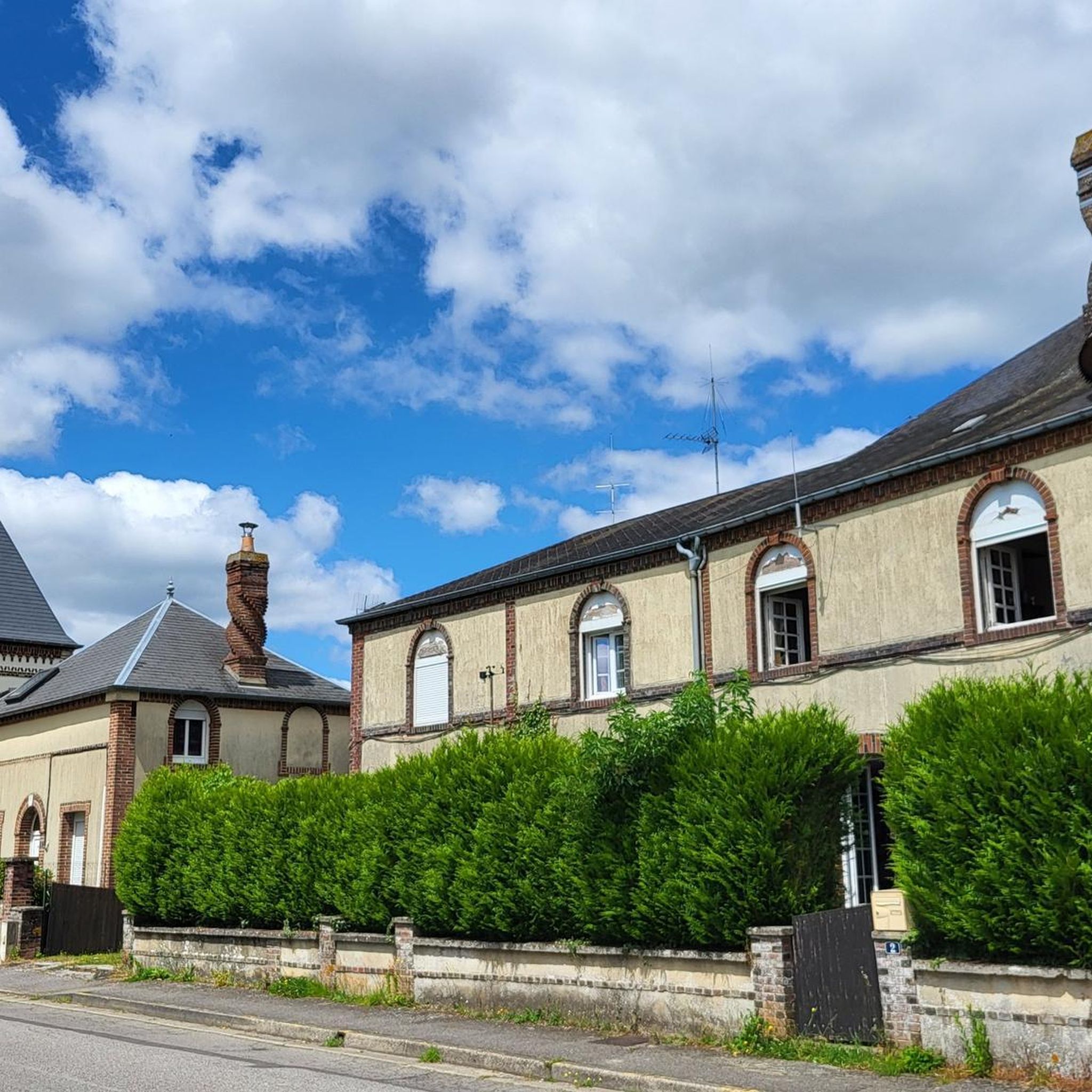
Church with a brick bell tower built between 1890 and 1898

번역: Google

0

0

생투앙 쉬르 이통 주변에서 가장 인기 있는 경로

생투앙 쉬르 이통 하이킹

생투앙 쉬르 이통 주변에서 가장 인기 있는 명소

Places to see

Store rating

komoot 모바일 앱으로 영감을 받아보세요

무료 komoot 계정로 끝없는 야외 모험을 손쉽게 찾고, 맞춤 설정하며 길안내할 수 있어요.

또는

지금 komoot에 가입하세요

Store rating

더 살펴보기

다른 지역의 최고의 로드 사이클링 경로를 살펴보세요.

퍼체브레톤셀레스생힐레르 쉬르 에르생 피에르 라 브뤼에르생제르맹 데그로아생힐레르 르 샤텔Saint-Martin-D'Écublei르 파생로머브레델오브Villiers-Sous-Mortagne에코르세이라 샤펠 비엘생 미셸 투뵈프라이생 심포리앙 데 브뤼에르라에글Saint-Sulpice-Sur-Risle레말라르 앙페르슈무송빌리에노르만델생 모리스 레 샤랑시이라이뷰리외라 마들렌 부베라 페리에르Saint-Martin-Du-Vieux-Belleme몽고드리찬다이투루브르 오페르슈라 메시에르Saint-Quentin-De-Blavou라 방트루즈발오페르슈크룰라이생드니 쉬르 휘스네무티에-오-페르슈쿠르 마지 쉬르 휘스네르 마지바조슈쉬르회엔Appenai-Sous-Belleme레베용로와사일생제르맹 드 라 쿠드르생제르맹 드 마르티니케밀리레 주네트벨루 르 트리샤르생투앙 드 라 쿠르쿨리머생랑지스 레 모르타뉴벨렘롱니 레 빌리지레 아스프레페르슈앙노세담마리로메 샤몽도컴블롯르 팽 라 가렌세톤오리니 르 부탱라 샤펠 수에프페르벤셰르생투앙 드 세쉐루브르생트 세론 레 모르타뉴라 샤펠 몽리종생 마르탱 데 페제리비다이베르드후이스코르본봉스물랭Saint-Fulgent-Des-OrmesMauves-Sur-Huisne르 게 드 라 셴베리에르레 메뉴Saint-Cyr-La-Rosière쿠르전솔리니-라-트라페오리니 르 루Saint-Aquilin-De-Corbion비트레이-수-라이글파르폰데발생주앙 드블라부세리니라 페리에르 오 도옌비주확신하는보파이Saint-Hilaire-Sur-Risle생 피에르 데 로주바누아즈보네포이이지바빌뷰레사블롱 쉬르 휘스네어게이즈샹포 쉬르 사르트푸브라이쿠주오보에세물랭 라마르쉐Saint-Aubin-De-Courteraie마헤루벨라빌리에생마르드레노에페레르 메닐 베라르요정생 줄리앙 쉬르 사르트

근처 어드벤처 가이드

생 미셸 투뵈프 즐길거리

background

새로운 정복을 위한 준비를 하세요

무료로 가입하기

탐험하기
경로경로 플래너기능하이킹MTB 트레일로드 사이클링 경로바이크패킹사이트맵
앱 다운로드
소셜 미디어에서 팔로우하기

© komoot GmbH

개인 정보 보호 정책