롱니 레 빌리지 최고의 라이딩 경로
4.5
(62)
916
자전거 타는 사람
26
라이딩
롱니 레 빌리지의 로드 사이클링 경로를 찾으시나요? 그렇다면 롱니 레 빌리지 로드 라이딩 컬렉션 중에서 가장 멋진 라이딩 장소를 아래에서 살펴보세요.
마지막 업데이트: 8월 26, 2026
7
자전거 타는 사람
34.8km
01:28
280m
280m
초급용 로드 라이딩. 모든 체력 수준에 적합. 지면 대부분이 잘 포장되어 있고 라이딩하기 쉬움.
5.0
(1)
11
자전거 타는 사람
34.1km
01:30
220m
220m
초급용 로드 라이딩. 모든 체력 수준에 적합. 지면 대부분이 잘 포장되어 있고 라이딩하기 쉬움.

무료 회원 가입
7
자전거 타는 사람
70.1km
02:59
370m
370m
보통 도로 자전거 타기. 좋은 체력 필요. 지면 대부분이 잘 포장되어 있고 라이딩하기 쉬움.
8
자전거 타는 사람
45.2km
01:50
250m
250m
초급용 로드 라이딩. 모든 체력 수준에 적합. 지면 대부분이 잘 포장되어 있고 라이딩하기 쉬움.
7
자전거 타는 사람
36.0km
01:31
170m
170m
보통 도로 자전거 타기. 모든 체력 수준에 적합. 투어 중 라이딩하기 어려운 비포장 구간이 있을 수 있음.
더 다양한 경로와 다른 탐험가들의 추천을 살펴보세요.
무료 회원 가입
이미 komoot 계정이 있나요?
투어 추천은 다른 사람들이 komoot에서 완료한 수천 개의 활동을 바탕으로 구성되어 있습니다.
오늘 무료 계정으로 시작하세요
다음 모험이 기다리고 있어요.
로그인 또는 가입하기


커뮤니티 팁

The original Marian shrine "La Salette," which is referred to in this patronal feast, is located in the French Alps (Grenoble district) and is an important Marian shrine, even if it has not achieved the same level of fame as other pilgrimage sites honoring the Mother of God—such as Lourdes in the French Pyrenees or Fatima in Portugal. The hiking highlight "La Salette" can be found on komoot at the following link =>> https://www.komoot.com/de-de/highlight/1861054
0
0

Church built in the 18th century 18th century altarpiece listed as a Historic Monument. A bell tower-porch marks the entrance to the façade. It has a portal. A triplet of louvres is located on each side, under the polygonal spire. Brick buttresses support the side walls and alternate with semicircular bay windows. The nave is unique, with enclosed pews. The paneled vault is barrel-shaped with transverse arches. The choir is adorned with a large altarpiece.
0
0


The church was built in 1865 by Father Migorel, who supposedly had three visions of a church to be built on a hilltop at the junction of three roads. It was consecrated in 1867 and opened for worship. The octagonal tower, erected in 1871, is decorated with polychrome bricks and topped with four turrets housing statues of archangels.
0
0
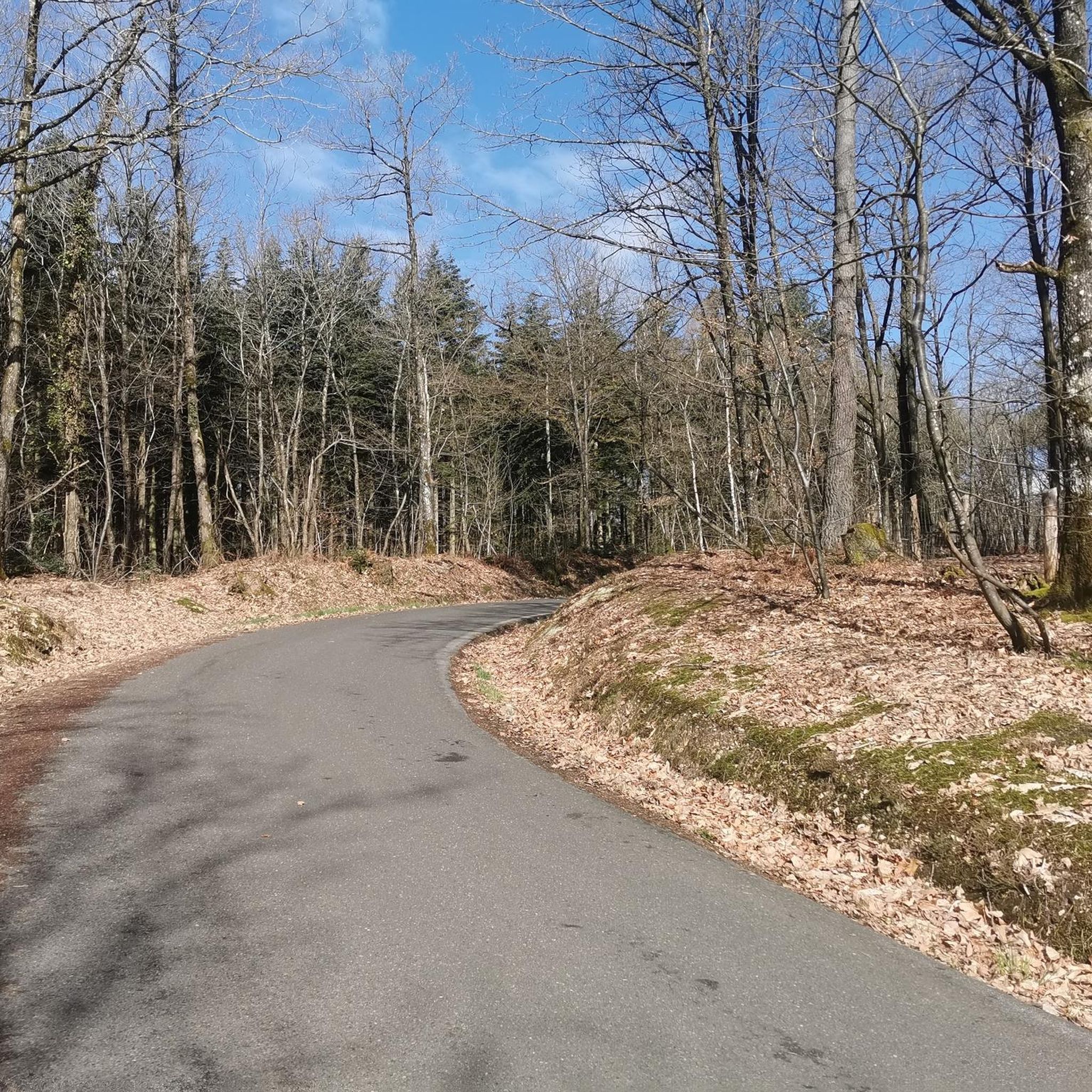
following a landslide, the road is blocked for about twenty meters, nothing problematic for cycling
0
0
With a very simple plan, with its tiled nave and its small slate bell tower on the ridge, the church surrounded by its cemetery, set back from the road, overlooks the countryside planted with trees. The river is nearby, and its flowing water evokes that of the baptism of Jesus in the Jordan, as soon as we see the statue of the patron, Saint John the Baptist, in the choir. His arm raised towards the sky reminds us of his preaching in the desert of Palestine: "Prepare for the coming of the Messiah...". On the thin banner attached to his staff are written the words: "Ecce Agnus Dei", by which he already announced that he saw in Jesus the victim freely offering himself as a sacrifice for the Redemption of all men. Placed on the ground against the wall, a 17th century painting. depicts Jesus immersed up to his knees in the waters of the river, leaning with his hands crossed on his chest to receive the baptism of penance from the hand of John kneeling on the bank. We see “the Spirit descending on him like a dove” and we recall the words of John reported in the Gospel: “I am not worthy to bow down at his feet… I have baptized you in water; he will baptize you in the Holy Spirit.” Beside him, the angel wearing Jesus’ clothes turns his face towards a young child whom he guides with a hand placed on his shoulder, as if to teach him the profound meaning of baptism. Above the arch through which the nave opens onto the choir, the group of Christ on the cross surrounded by Mary and Saint John the Evangelist is a fine example of 16th century religious sculpture, faithful to traditional iconography. Similarly, at the back of the nave is the charming naive statue of Saint Fiacre: this young monk from Ireland loved to cultivate the vegetable garden of his monastery, near Meaux. Patron saint of gardeners, he holds his spade, and in the Perche region he was also invoked to cure various illnesses. More unique in style, the large Renaissance chest serving as a central altar was the former “work bench of the factory” reserved for the administrators of the parish’s resources and expenses. Let us admire the skill and imagination of the cabinetmaker who carved this series of full-length figures in oak under the arcades separated by “terms” inspired by Roman antiquity. Their distinctive attributes make us recognize Saints Christine, Barbara, Madeleine and Catherine on the front, and on the sides Saints Peter and Paul on the right, John the Baptist and Bartholomew on the left. Their silhouettes are more reminiscent of fairy tale characters…
0
0
In the nearby park shaded by large trees, the ruins of fortifications recall the memory of the six towers of the old castle built in the 11th century……. In the nearby park shaded by large trees, the ruins of fortifications recall the memory of the six towers of the old castle built in the 11th century by Geoffroy IV, Count of Perche, in order to control this border region near the Chartres region, Normandy, and the possessions of the Lords of Bellême and Alençon which extended as far as Sées. During the Hundred Years' War, Charles, Count of Evreux and King of Navarre, allied with the English against the King of France, seized the fortress in 1364. It was then besieged and retaken on behalf of King Charles V by his younger brother Philip the Bold, Duke of Burgundy, using catapults that threw large stones to collapse sections of the walls. But after the English victory at Verneuil in 1424, they rushed to destroy Marchainville, setting fire to the town and the castle. The church, too, has experienced some vicissitudes. It occupies the site of a very old small monastery, given to the abbey of Saint-Evrouit by a certain Fulchierus of Chartres, who was chaplain to Baldwin I, King of Jerusalem and author of an account of the first crusade. The monks built the priory church in the 11th century, of which the thick right wall with its flat buttresses, the cornice in grison stone, and the support points of the descending roof, which housed a small adjoining cloister, still remain. The church was enlarged (end of the 15th or beginning of the 16th century) along its entire length by a side nave resting on stone arches, whose voussures connect without capitals to octagonal pillars. On the unfortunate initiative of Abbot Fleuriel, this side nave was knocked down in 1723, and the roof of the church lowered. It was not until 1810 that a new priest, Abbot Dubois, had the four arcades of the current chapel of the Virgin reopened. The three other old arcades, still visible, remain blocked in the left wall of the nave. Unfortunately, on March 15, 1820, the shock of an earthquake caused the old square bell tower of the priory, which was located above the entrance to the choir, to collapse, which caused considerable damage. Thanks to the generosity of the inhabitants and the personal contribution of the Bishop of Séez, the church was repaired and a new bell tower was erected next to the entrance porch in 1824. On the classical-style altarpiece, a painting, dated 1949, of the Holy Virgin surrounded by angels replaces the painting of the Assumption hanging in the nave. The 18th century tabernacle presents a pretty wooden statuette of the resurrected Christ, with on each side those of a holy bishop with a kneeling donor, and perhaps a Father of the Church. Two pretty statues of Saint Lawrence and Saint Peter adorn the altarpiece of the chapel of the Virgin, where in the center appears the traditional image of Our Lady of Victories presenting Jesus as a child on a starry sphere that symbolizes the world. Above, appear God the Father, his arms outstretched, and the Holy Spirit. Finally, let us not forget the curious statue of Saint Louis with his scepter, presenting the crown of thorns and the three nails of the crucifixion, nor the ancient painting, in the nave, of Saint Eloi as bishop, with his anvil of patron saint of blacksmiths.
0
0
A flowery village, Moussonvilliers takes particular care of the surroundings of its church. By walking along flower beds, you can access it via the covered porch, off-centre with respect to the axis of the gable, the corners of which are reinforced with double buttresses. The church has two naves of unequal width, gathered under the same roof. Built in the 16th century, its poor condition probably required the alterations carried out in the 19th century. From the outside, you can see in particular the use of bricks for the repair of the windows and the cornices of the roof. Inside, between the two parallel naves, the four stone pillars cut into a prism, dating from the construction, carry a wide horizontal band along the entire length of the building (probably made of large beams covered in plaster, replacing the old stone arcades). This band reinforces the beams on which the "tie beams" of the exposed framework rest, and at the same time supports the fall of the two plaster vaults. These structural modifications nevertheless respect the general appearance of the building. At the central altar, the tabernacle evokes the parable of the Good Shepherd who carries the lost sheep on his shoulders. Above, the classical style altarpiece in wood with decorations enhanced with gold, is decorated in the center with a large painting of the Assumption of Mary taken up to heaven by angels. The landscape placed very low accentuates the upward movement of the composition. This painting, of a certain artistic quality, dated 1855, is signed by Claire Hombcrg. Two statues frame it in the niches: on the left, a pretty Virgin in polychrome stone from the 16th century. Crowned with fleurs-de-lys and draped in a blue cloak, she holds the infant Jesus, who stretches out his arm towards the object she is presenting to him (an apple or a bird? We do not know because the right hand is broken). On the other side, in polychrome wood from the 18th century, Saint Catherine of Alexandria reading a book, was once invoked as the patron saint of schools because of her in-depth education. She had in fact publicly and successfully refuted the erroneous theses of several philosophers whom she converted to the Christian faith. She suffered martyrdom in the 4th century. Other statues deserve particular interest. Leaning against a pillar, the 16th century, in stone, of Saint John the Baptist, his cloak raised over his bare legs, presenting the Mystic Lamb placed on the large book of the Bible. And also, from the same period, the small polychrome stone sculpture depicting the education of the Virgin Mary by Saint Anne. It is difficult to see the details because it is placed in a niche above the door. But it is a precious ancient testimony of the devotion to the patron saint of our parish Sainte-Anne-du-Perche. Finally, to the left of the door, the polychrome wooden statue of Saint Paul. The expression on his face reflects somewhat the ardor of his vocation as an apostle of Christianity. Converted by his vision of the road to Damascus, he devoted himself entirely to preaching the doctrine of Christ the Redeemer, traveling through the countries of the Hellenized East to found and lead new communities of baptized people. Thanks to him, the evangelical message was not limited to populations of Jewish culture, but was addressed to people throughout the world. His writings are an ever-current and living source of the doctrine of the Church, the body of Christ.
0
0
롱니 레 빌리지 주변에서 가장 인기 있는 명소


더 살펴보기
다른 지역의 최고의 로드 사이클링 경로를 살펴보세요.
