에이콘 최고의 라이딩 경로
4.1
(28)
312
자전거 타는 사람
141
라이딩
에이콘의 로드 사이클링 경로를 찾으시나요? 그렇다면 에이콘 로드 라이딩 컬렉션 중에서 가장 멋진 라이딩 장소를 아래에서 살펴보세요.
마지막 업데이트: 10월 5, 2026
12
자전거 타는 사람
40.7km
01:40
210m
210m
초급용 로드 라이딩. 모든 체력 수준에 적합. 지면 대부분이 잘 포장되어 있고 라이딩하기 쉬움.
4.0
(3)
7
자전거 타는 사람
28.1km
01:22
170m
170m
초급용 로드 라이딩. 모든 체력 수준에 적합. 지면 대부분이 잘 포장되어 있고 라이딩하기 쉬움.

7
자전거 타는 사람
32.6km
01:25
260m
260m
초급용 로드 라이딩. 모든 체력 수준에 적합. 지면 대부분이 잘 포장되어 있고 라이딩하기 쉬움.
4
자전거 타는 사람
32.7km
01:20
170m
170m
초급용 로드 라이딩. 모든 체력 수준에 적합. 지면 대부분이 잘 포장되어 있고 라이딩하기 쉬움.
5
자전거 타는 사람
46.1km
02:01
320m
320m
보통 도로 자전거 타기. 좋은 체력 필요. 지면 대부분이 잘 포장되어 있고 라이딩하기 쉬움.
더 다양한 경로와 다른 탐험가들의 추천을 살펴보세요.
이미 komoot 계정이 있나요?
투어 추천은 다른 사람들이 komoot에서 완료한 수천 개의 활동을 바탕으로 구성되어 있습니다.
오늘 무료 계정으로 시작하세요
다음 모험이 기다리고 있어요.
에이콘 주변 인기 장소


커뮤니티 팁


The first mention of the existence of the Church of Saint-Martin de Nonancourt is a 12th-century charter, but the original building probably dates back to the 7th or 8th century. The bell tower that now occupies the middle of the façade dates from the reconstructions of 1204. During the Hundred Years' War, the church was largely destroyed, like many buildings in the region. The side aisles, nave, and choir were rebuilt in the 16th century. The Chapel of the Virgin, also known as the Chapel of the Rosary, was also added. The Church of Saint-Martin contains numerous works of art, some of which are listed: neo-Gothic and Renaissance furnishings, including the centerpiece, the pulpit, a veritable wooden lacework; a variety of statuary, a 16th-century organ case and finally an enigmatic fresco discovered during recent works in 2001. The stained-glass windows of the church constitute a truly remarkable collection, both in terms of their number (26 in total) and their quality. The lower windows of the nave are the oldest pieces, dating from the 1500s, while the upper windows date from the 1520s and 1530s.
0
0
The current church was almost entirely rebuilt in 1542 on Gothic foundations. The Gothic church was reportedly destroyed in 1424 by the English. According to legend, Saint Lubin, Bishop of Chartres, came to rest in this place, which housed a recluse inhabited by a monk. A chapel was built there towards the end of the 6th century.
0
0
Built in the 15th century on the foundations of a chapel whose origins can be traced back to a papal bull from Pope Alexander in 1142, Saint Apollonia was worshipped there.
0
0
The Notre-Dame Priory, founded around 1128 by Rahier de Muzy, was dependent on Coulombs Abbey and housed a community of Benedictines. This community was apparently never very large, as Eudes Rigaud's repeated visits in the 13th century only recorded four monks. In 1255, the monks no longer lived together at the priory due to lack of space. By 1269, the buildings were in too poor condition to accommodate the archbishop. Adjoining the convent buildings, the choir of the parish church of Saint John the Baptist was used by the monks. This 12th-century church, built "in a single heap," underwent several embellishments in the 18th century, but on July 21, 1794, it was probably converted into a saltpeter works, along with the entire priory. The church reopened for worship on March 22, 1795. A campaign of renovations restored the buttresses of the west facade with bricks at the end of the 19th century. The bell tower, damaged in 1944 during the fighting on the Avre, was restored in 1959. The monument was closed for another period from 1939 to 1950. The bells were electrified in 1985. Heating was installed in 1990. A restoration project for the entire building was adopted by the municipality in 2003. The roofing work—repairing the roof box—and the complete restoration of the north facade—raising the apron of the openings by approximately 40 centimeters, repairing all the buttresses and old lime plaster—were completed in 2006. The Church of St. John the Baptist has been listed on the supplementary list of historic monuments since December 2005. A competition to select a master glassmaker was held in April 2009. The winning candidate, Coline Fabre, was entrusted with the task of creating The stained-glass windows throughout the building. Four bays were installed in the spring of 2010 and eight in the summer of 2014, so that all bays on the north, east, and south facades were fitted with stained-glass windows. Rehabilitation work on the east and west facades and the installation of the stained-glass windows on the west facade began on November 20, 2018, and was completed at the end of June 2019. The stained-glass windows were inaugurated on September 13, 2019. Since February 2021, the bells have once again rung daily at 12:00 p.m. and 7:00 p.m.
0
0
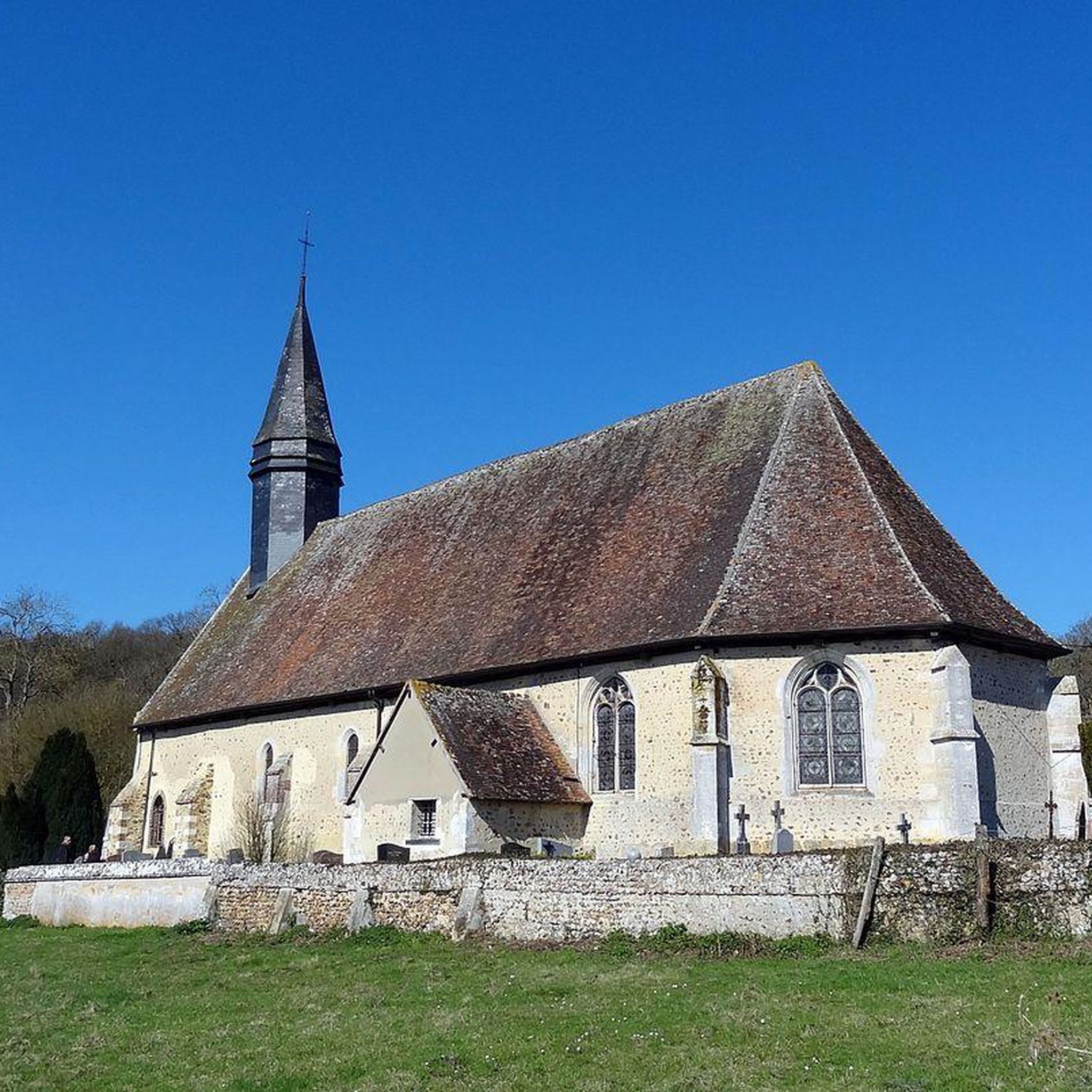
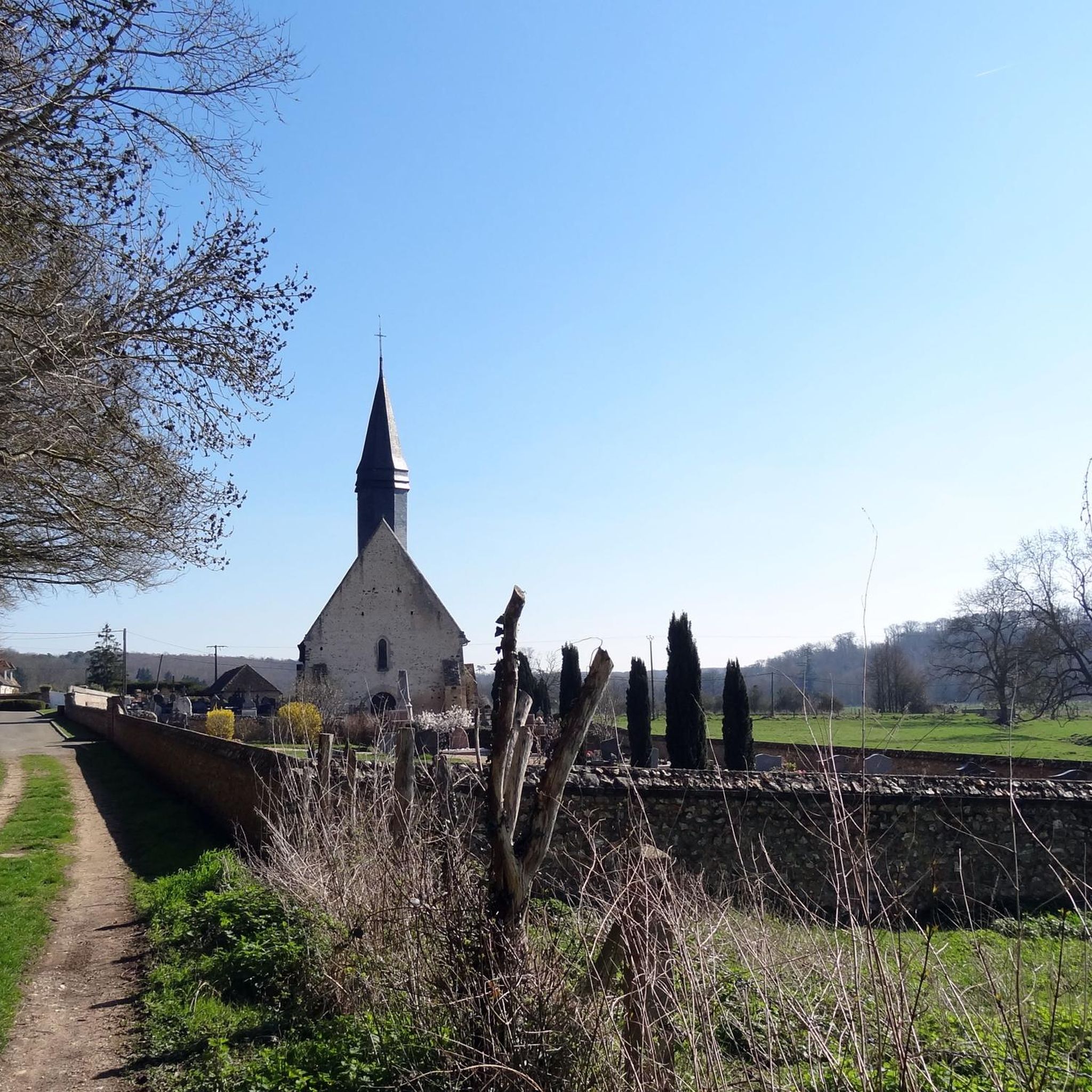
Notre-Dame-des-Puits Chapel. This Marian chapel, the foundation of which is the subject of a legend, dates back to the 12th century: while digging a well, a villager is said to have found a statue of the Virgin that he took to the parish church of Droisy, but which returned to the well three times at night, a miracle that reflected the Virgin's desire to see a chapel dedicated to her in this place. The building seems to have suffered heavy damage during the wars of the 15th century, like the surrounding villages, but, rebuilt in the following century, it was invoked against plague epidemics and was the site of new miracles. A brotherhood, created in the 18th century, ensured the organization of festivals and pilgrimages, and contributed to the purchase of the furniture: it is to them that we owe the order for the altar and its altarpiece, as well as the stained glass windows. Confiscated during the Revolution, the chapel was bought back by the faithful who reconstituted a brotherhood. In contemporary times, it was enlarged to the west by the construction of a porch, probably to facilitate access to the building on pilgrimage days, and two doors were opened there, one to the west, the other to the south. It is a building with a quadrangular plan of fairly large dimensions, with a modest wooden bell tower which has kept its bell from 1775. On the almost blind north facade, a small sacristy was added at the level of the choir. From its origins, it has retained, at the chevet, only fragments of masonry in grison and the trace of two bays. Renovations in the 15th and 16th centuries date several openings, including a pointed window with a trilobed network in the southern wall and a thick buttress halfway up the chevet. The interior of the building is covered with a wooden vault that was in poor condition. The church has a large amount of furniture, the masterpiece of which is undoubtedly the magnificent altarpiece, dated 1644, the work of Jean Racine, a painter and sculptor from Rouen; the iconography of the whole is dedicated to the Holy Family and the painting represents the Nativity. The work is set between two fluted columns and two pilasters, under a broken pediment and a niche in which a Virgin and Child, adored by two angels, has been placed. In front of each pilaster, two monumental statues have been placed, on the right Saint Anne and the Virgin, on the left Saint Joseph and the Child Jesus. The main altar is framed by two side altars, placed slightly back and at an angle and connected to each other by paneling; two doors were opened on the right and left in this woodwork to allow access, behind the altar, to the miraculous well which was located slightly below the apse For the repair of the covering paneling, the Sauvegarde de l’Art français granted aid of €10,000 in 2008.
0
0
The Saint-Rémy church in Saint-Rémy-sur-Avre is dedicated to Saint Remi of Reims, Bishop of Reims who baptized Clovis in 496 in the Notre-Dame Cathedral of Reims. In the 12th century, it marked the border between the Duchy of Normandy and the French royal domain on which Saint-Rémy-sur-Avre depends. It is a flamboyant Gothic church from the 15th century, probably rebuilt since we have mention of its existence since the end of the 11th century.
0
0
에이콘 주변에서 가장 인기 있는 명소


더 살펴보기
다른 지역의 최고의 로드 사이클링 경로를 살펴보세요.
