20의 산토 스테파노 델 솔레가지 명소 & 주요 장소
산토 스테파노 델 솔레에는 둘러볼 만한 장소가 많답니다. 하이킹 또는 사이클링을 좋아한다면 산토 스테파노 델 솔레에 숨겨진 20
가지 보석을 만날 수 있을 거예요. 이 지역의 주요 명소를 살펴보면서 다음 모험을 계획해보세요.
마지막 업데이트: 8월 30, 2026

Civita di Ogliara 고대 성벽
하이라이트 • 역사적 장소
번역자 Google •
팁에 의해

이런 장소를 발견하려면 지금 가입하세요
최고의 싱글 트랙, 봉우리 및 다양한 흥미로운 야외 장소에 대한 추천을 받아보세요.
무료 회원 가입
세리노의 산티시모 살바토레 성지
하이라이트 • 종교적 장소
번역자 Google •
팁에 의해
산타 마리아 델라 네베 교회
하이라이트 • 종교적 장소
번역자 Google •
팁에 의해
Chiesa di Sant'Antonio di Contrada
하이라이트 • 종교적 장소
Dating back to 1756, its structure, with essential architectural lines, dominates …
번역자 Google •
팁에 의해
무료로 가입하여 산토 스테파노 델 솔레 주변의 더 많은 명소를 발견하세요.
무료 회원 가입
이미 komoot 계정이 있나요?
오늘 무료 계정으로 시작하세요
다음 모험이 기다리고 있어요.
로그인 또는 가입하기

커뮤니티 팁

In the locality of Ogliara, immersed in the Serino forest, there is the city wall of the "Civita di Ogliara", according to tradition, it is that of the mythical Sabatia, city of the Hirpini, whose inhabitants, following its destruction, were forced to flee thus giving life to the residential areas of Serino, Solofra, Montoro and Montella
0
0

https://it.wikipedia.org/wiki/Monte_Mai from https://www.ulyxes.it/monte-mai-ee: The name of the Monti Mai certainly derives from the Latin word "maior", large. Some ancient papers and the same reports of Giustino Fortunato, illustrious explorer of the Picentini, also report the diction Maj. Main ridge of the homonymous mountain group, elongated in the ESE-WNW direction, the peak is located at the convergence of three ridges, impervious and interrupted by gaps, rocky crags and secondary peaks. The Monti Mai belong to the westernmost subgroup of the Monti Picentini, one of the largest mountain groups in southern Italy and part of the homonymous regional park. They are characterized by Mesozoic carbonate platform rocks and to a lesser extent by Triassic dolomites and marls. The vegetation that covers the Monti Mai is mainly represented by beech trees that cover the upper part, over 800 m, and chestnut trees on the slopes. The fauna, very rich, like that of all the Picentini Mountains, consists of large mammals, such as the wolf, the fox, the badger, the wild boar; birds of prey such as the peregrine falcon, the buzzard, the sparrowhawk, the goshawk; the black woodpecker, long-eared owl, dipper, kingfisher; amphibians such as the Apennine frog, the European green toad, the spectacled salamander, the fire salamander.
3
0

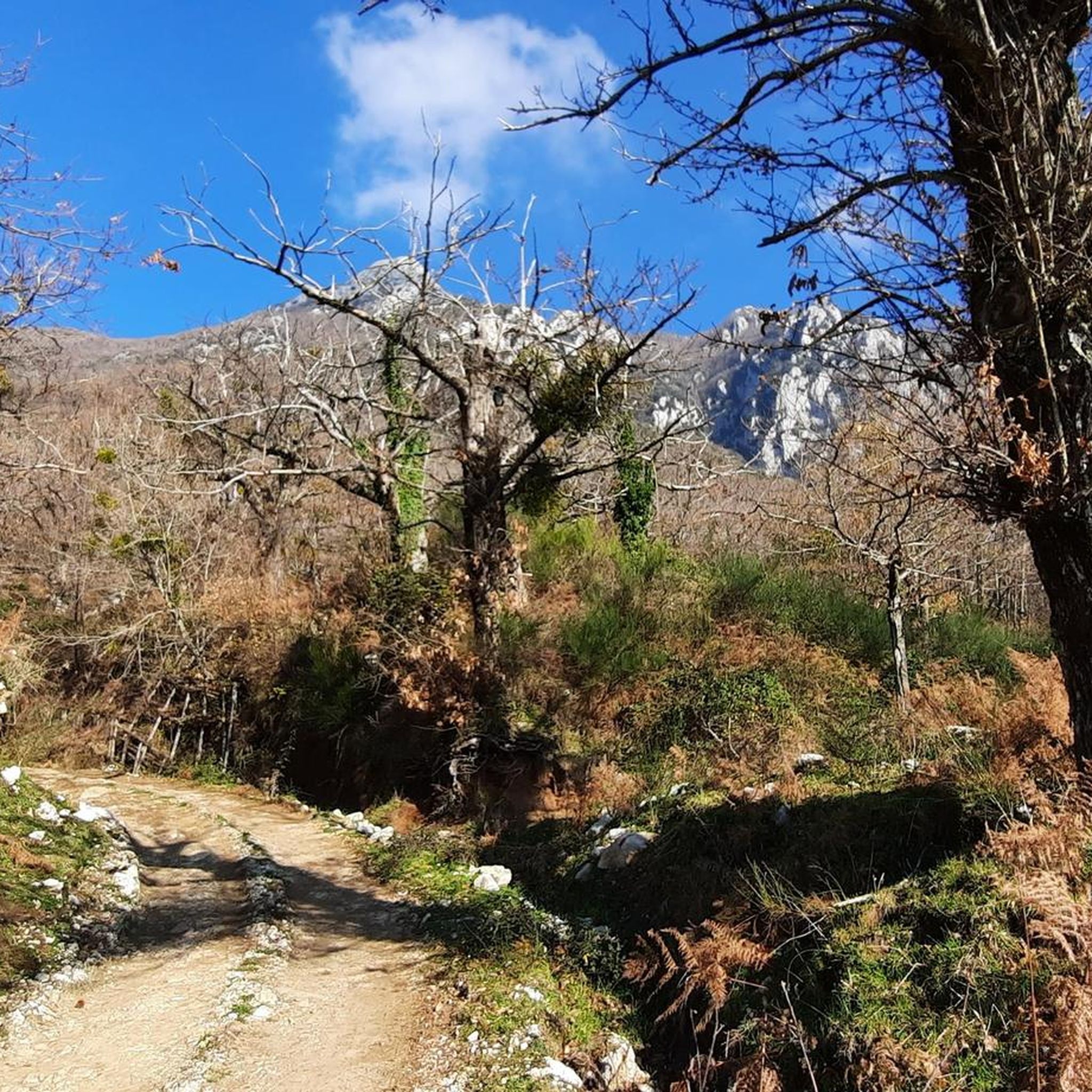
Summit of Monte Mai, where you can admire a breathtaking view that ranges from the Gulf of Salerno to Vesuvius, with an overview of the highest peaks of the Picentini Mountains.
3
0

Really suggestive place that deserves to be visited.
4
0

Walls Civita di Ogliara, accessed from a dirt road to the left of the picnic area
3
0
Immersed in the Bosco di Serino, in the locality of Ogliara, on a small plateau bordered by the river Sabato, there is a wall with a circumference of about 2 kilometers, known as “Civita di Ogliara”. According to an ancient tradition that began with Cluverio, in the seventeenth century, the "Civita di Ogliara" would be the walls of the city of "Sabazia", capital of the Samnites of Irpinia and from which the Sabatini would take their name. Cluverio writes: “Of the rivers that starting from the territory of the Irpini flow into the Volturno, the first is the Sabatus river, now commonly called Sabato. This river had this name from so ancient times that the Sabatini population took its name from it ... It seems that there was a fortified place near the river, called Sabazia, from which its inhabitants took the name of Sabatini . Where they were is uncertain. However, it is believed that this place was located between two fortified towns, which are commonly called Terranova and Prata ”. The myth is fueled by Bella Bona who claims that "Sabatia" was founded by a mythical progenitor of Noah who survived the universal flood named Sabatio and that the city was located in the valley between the mountains of Serino in the place called Ogliara, with citizens Sabatini. The myth also envelops what is said of its destruction; some authors say that "Sabatia" was destroyed by Hannibal during the Second Punic War, others, on the contrary, argue that it was destroyed by the Romans to punish the Sabatini who became Hannibal's allies, others still want it destroyed by Silla at the time of Social War (89 BC). Beyond the myth, no historical source from Tito Livio to other ancient writers has ever mentioned the existence of the city of "Sabatia" and nettampoco the link between this city and the walls of the Ogliara area. Even the historian Francesco Scandone has excluded this correlation, arguing, instead, that the "Civita di Ogliara" is a stronghold dating back to the time of the civil war between Count Siconolfo and Radelchi for the dominion of the Duchy of Benevento, wanted by Radelchi to to prevent the advance of an enemy army which from Salerno could have invaded the valley of Sabato. The hypothesis advanced by Scandone was confirmed by various archaeologists who were interested in the walls and towers of Civita Ogliara, starting with Woolley and ending at Pasquale Natella. https://www.sguardisullirpinia.it/guide-turistiche-360/serino/visita-serino/civita-di-ogliara.html
15
0

Beautiful sanctuary carved into the rock! Stunning panoramic view
3
0

On the slopes of Mount Terminio, in the territory of Serino, there is the ancient sanctuary of the Santissimo Salvatore, entirely dug into the rock and adapted for liturgical and residential use for a small hermit community. The cave seems to have been excavated around the end of 1300 by a Benedictine religious community that resided at the time in the Abbey of Cerreto. Inside are the statues of the Holy Savior and of San Michele Arcangelo. The Grotta del SS. Salvatore was formerly called the cave of the Angel or of San Michele. It is located, together with other caves, on what is called the path of the Angel. It is flanked by a hermitage that served as a refuge for pilgrims and all visitors who took the arduous path that led to the cave, reachable in about 3 hours of walking.
23
0
산토 스테파노 델 솔레 주변에서 가장 인기 있는 명소


더 살펴보기
찾고 있는 하이라이트를 아직 못 찾으셨나요? 다른 지역의 주요 명소 가이드를 확인해보세요:
