20의 부잔가지 명소 & 주요 장소
부잔에는 둘러볼 만한 장소가 많답니다. 하이킹 또는 사이클링을 좋아한다면 부잔에 숨겨진 20
가지 보석을 만날 수 있을 거예요. 이 지역의 주요 명소를 살펴보면서 다음 모험을 계획해보세요.
마지막 업데이트: 10월 10, 2026
샤토 드 라 트랑샤드
하이라이트 • 성
번역자 Google •
팁에 의해

모르낙 생마르탱 교회
하이라이트 • 기타
This …
번역자 Google •
팁에 의해

이런 장소를 발견하려면 지금 가입하세요
최고의 싱글 트랙, 봉우리 및 다양한 흥미로운 야외 장소에 대한 추천을 받아보세요.
디냐크의 생시바르 교회
하이라이트 • 종교적 장소
번역자 Google •
팁에 의해

투브르 생트 마들렌 교회
하이라이트 • 기타
번역자 Google •
팁에 의해
무료로 가입하여 부잔 주변의 더 많은 명소를 발견하세요.
이미 komoot 계정이 있나요?
오늘 무료 계정으로 시작하세요
다음 모험이 기다리고 있어요.



커뮤니티 팁

The building, constructed in the 12th century, was enlarged in the 15th century by the north and south aisles dedicated to the Virgin and Saint John the Baptist. It was restored in 1875-1876. It has a basilica plan with a single nave, on which is grafted to the east a false square surmounted by a dome on pendentives and which ends in a vaulted apse. Side chapels with flat chevet were added, to the north and south, in the 15th century. The facade is pierced by a door with a triple projection and an open window. The building was fortified at the time of the Hundred Years' War. The whole is surmounted, to the east, at the level of the dome, by a square bell tower on two levels. The base is decorated with three blind arcades; The upper floor is decorated, on each side, with three semicircular arches mounted on small columns, highlighted by a circular stringcourse and enclosing twin bay windows. https://www.dignac.fr/histoire-et-patrimoine/ https://monumentum.fr/monument-historique/pa00104355/dignac-eglise-saint-cybard
0
0

After the Blessed Virgin Mary, "Sainte MARIE MADELEINE" is the woman most frequently mentioned in the writings of the New Testament. Originally called "Mary of Magdala" after her place of origin on the Sea of Galilee, over time the name "Mary Magdalene" has been formed. According to the biblical accounts, she is one of the women and men who followed Jesus of Nazareth. According to the testimony of the evangelists, Mary Magdalene is also one of the three women who, after the crucifixion and burial of Jesus Christ, wanted to anoint the body on Easter morning after the Sabbath rest, and the very first person who ever met the Risen Christ. In theology, she is therefore also known as the "Apostle of the Apostles". The feast day of Sainte Marie-Madeleine in the calendar of saints is July 22nd.
0
0

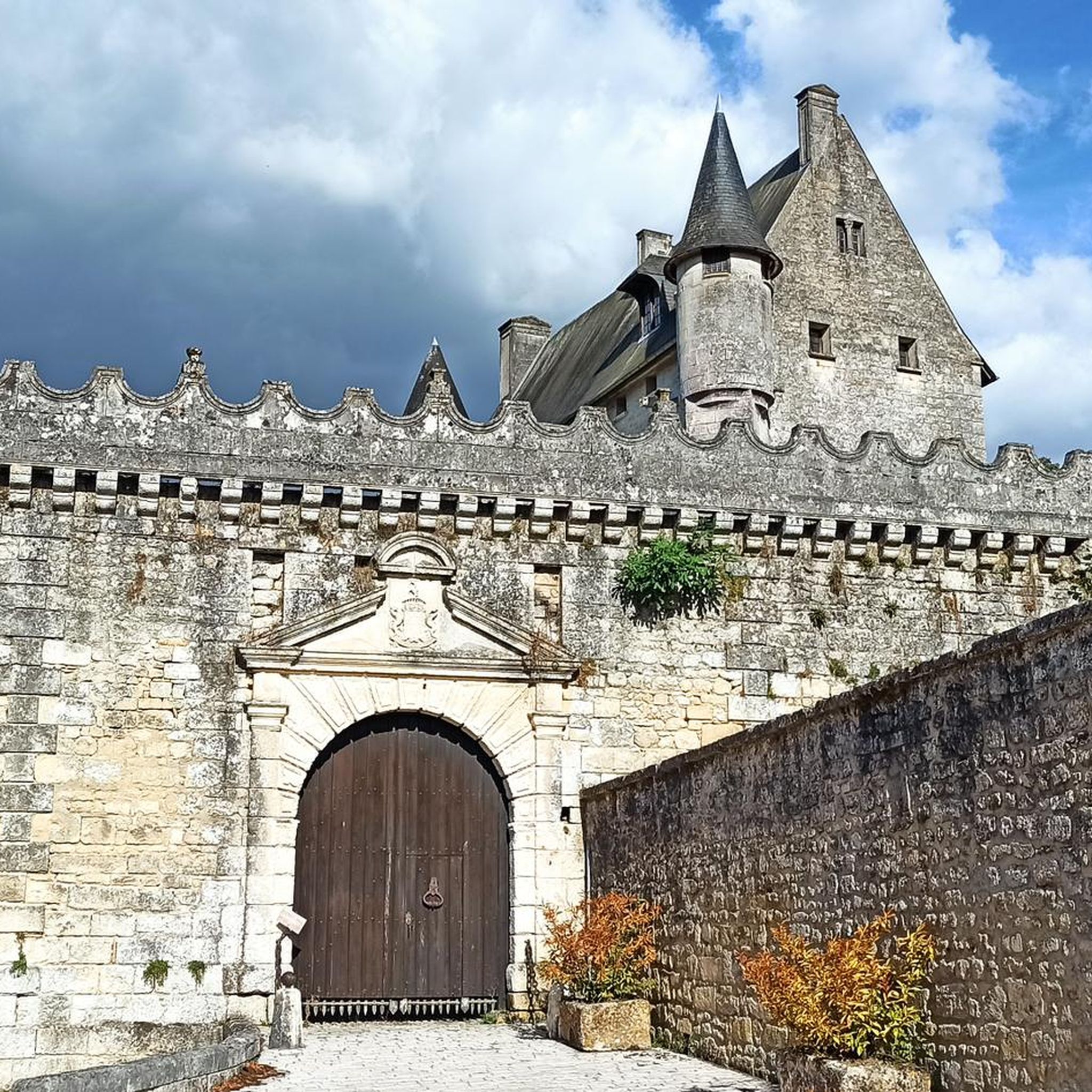
The Château de la Tranchade dominates the Anguienne valley on a rocky outcrop protecting the south-eastern access to Angoulême. A strategic stronghold to control Angoulême, La Tranchade has often been besieged.
4
0

The church is located on a rocky outcrop where was also the old castle, it dominates the sources of the Touvre to the south. It dates from the 12th century and has four capitals listed as historic monuments in the nave. The western part dates from the middle of the 12th century and the choir from the end of the same century. Half-ruined in 1631, the church was restored shortly afterwards, then in 1755. The northwest corner of the nave was erected in the 17th century. In 1845, it received brick vaults. A steeple overflowing in place of the one that existed on the false square.
1
0
The castle was, in the Middle Ages, the seat of one of the most important seigneuries of Angoumois. In the 12th century, La Tranchade was part of the domains of the abbey of Saint-Cybard. In the 14th century, it belonged to the lords of Pressac. The entrance to the estate is via a postern flanked by two asymmetrical square towers, with a parapet on machicolations decorated with shells. A bridge replaced the old drawbridge and crosses the moat dug in the rock. The building is made up of two square buildings, backing onto the keep. The latter is the oldest part, built towards the end of the 14th century. It is rectangular with a blind facade. A hexagonal tower containing the spiral staircase is attached to it. Both are crowned with battlements. The other part of the main courtyard was built in the 17th century. The windows of the south-eastern facade are framed by flat pilasters resting on consoles.
1
0
This building, known from 1110, was rebuilt for the first time around the middle of the 12th century and has undergone other transformations which have modified its original appearance. This building, known from 1110, was rebuilt for the first time around the middle of the 12th century and has undergone other transformations which have modified its original appearance. The history of the church reveals to us that two priests left a memory in the life of the parish: Jean Vergereau named in 1661, died on May 2, 1708 and was buried in the sanctuary; François Faunier du Plessis, who arrived in Mornac on January 18, 1778, was deported to Ile Madame. He died there on September 2, 1794 following ill-treatment inflicted by the revolutionaries. A commemorative plaque was awarded to him on April 28, 1929. The portal is framed by two fonts dating from the 17th century. A coat of arms decorates the first floor. The bell tower has two bells. The oldest dates from 1564 or 1584 and the second dates back to 1724. Some stones carved or engraved by the Compagnons du Tour de France, vestiges of these restorations, appear in the walls of the village. The sacristy has a paved floor made up of these small stones called "Dent de Loup" or "Cœurs de demoiselles".
0
0
12th century Romanesque church. The west facade has two buttresses rising to the top at its ends. Double buttresses correspond to the western pilasters of the dome and small ones are placed to the west of the nave, on the chapel and the apse. The rectangular bell tower has a first floor with arches, resting on a molded cordon. On another cordon, loaded with vertical billets, rises a second floor, the walls of which are pierced with rectangular openings. Inside, the nave has no vault. Its western and southern walls were dated back to the 17th century. Part of the pavement of the nave is made up of funerary slabs, bearing the representation of the working instruments of the deceased. A covered wooden chapel is supported to the north. It communicates with the nave by two wide arches. The false square, under the bell tower, carries a dome on horns, the departures of which rest on horizontal cords.
1
0
부잔 주변에서 가장 인기 있는 명소


더 살펴보기
찾고 있는 하이라이트를 아직 못 찾으셨나요? 다른 지역의 주요 명소 가이드를 확인해보세요:
