6의 라 코르누이유가지 명소 & 주요 장소
라 코르누이유에는 둘러볼 만한 장소가 많답니다. 하이킹 또는 사이클링을 좋아한다면 라 코르누이유에 숨겨진 6
가지 보석을 만날 수 있을 거예요. 이 지역의 주요 명소를 살펴보면서 다음 모험을 계획해보세요.
마지막 업데이트: 8월 25, 2026
Candé의 에르드르강 위 다리
하이라이트 • 다리
번역자 Google •
팁에 의해

레 푸르 드 라 뵈리에르
하이라이트 • 역사적 장소
번역자 Google •
팁에 의해

이런 장소를 발견하려면 지금 가입하세요
최고의 싱글 트랙, 봉우리 및 다양한 흥미로운 야외 장소에 대한 추천을 받아보세요.
무료 회원 가입
빌르무에상 코망데리
하이라이트 • 종교적 장소
번역자 Google •
팁에 의해

생드니 드 칸데 교회
하이라이트 • 종교적 장소
Its facade with two square bell towers evokes the great Gothic cathedrals, such as Notre-Dame de Paris.
번역자 Google •
팁에 의해

샹 뒤 루소 고인돌
하이라이트 • 기타
fr.wikipedia.org/wiki/Dolmen_du_Champ-du-Ruisseau
번역자 Google •
팁에 의해

무료로 가입하여 라 코르누이유 주변의 더 많은 명소를 발견하세요.
무료 회원 가입
이미 komoot 계정이 있나요?
오늘 무료 계정으로 시작하세요
다음 모험이 기다리고 있어요.
로그인 또는 가입하기
커뮤니티 팁

The Champ-du-Ruisseau dolmen, also known as the Pontpiau covered alley, was only discovered in 1949 by Dr. J.-B. Glotin. The site was reused during the Gallo-Roman period. The building was listed as a historic monument in 1961. https://fr.wikipedia.org/wiki/Dolmen_du_Champ-du-Ruisseau
1
0
Building and chapel built in the 12th century by the Knights Templar. This particularly well-preserved chapel is unique in Anjou. https://angerslumiere.blogspot.com/2016/08/la-commanderie-de-villemoisan.html
0
0

Car-free rolling path from Carquefou to Candé.
0
0

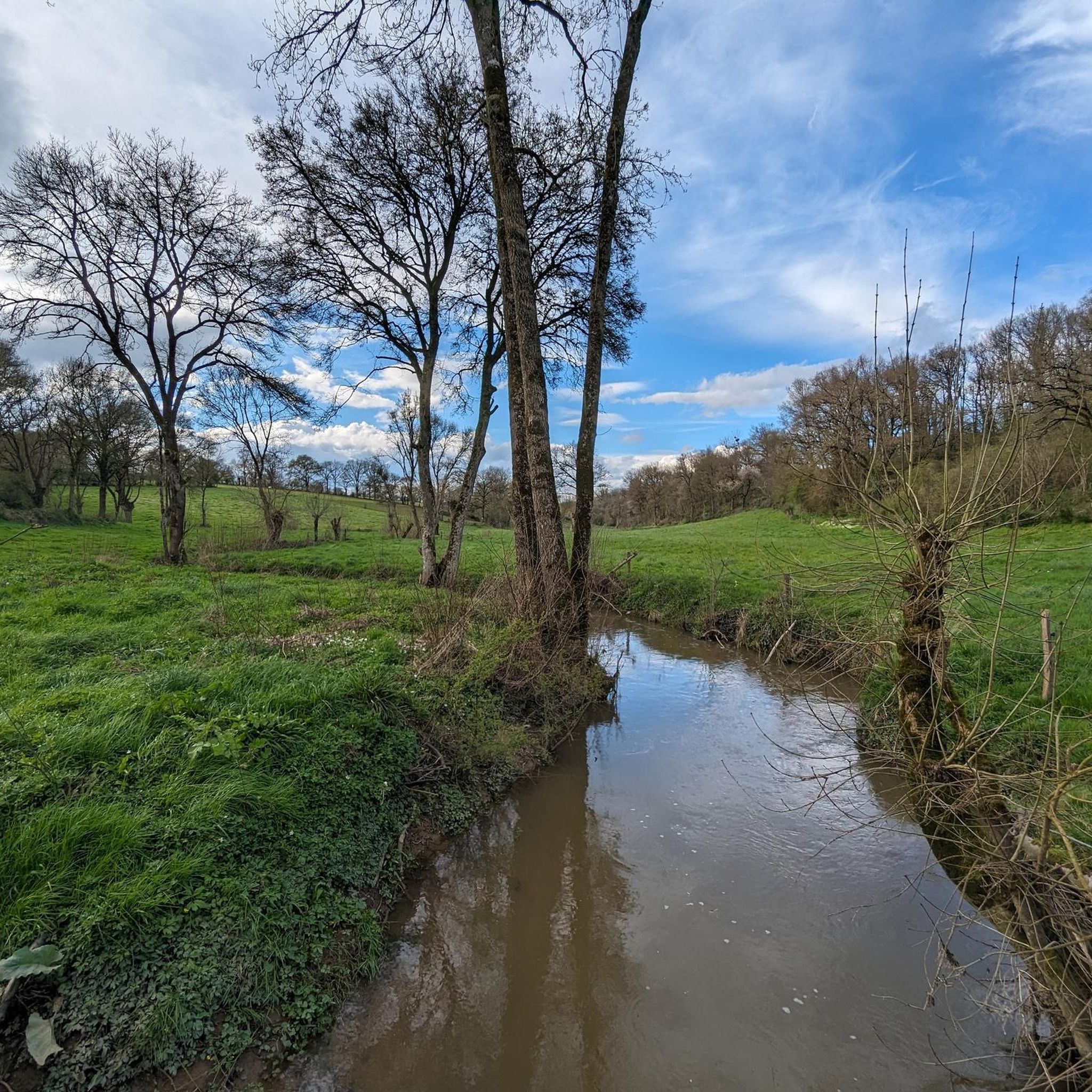
Entering Candé via the greenway, in a quiet & bucolic setting, is very pleasant. Passage over the Erdre, which at this point is still only a stream
0
0

Dating from the 19th century, the Veurière (or Saint-Anne) lime kilns are Angevin industrial buildings located in Angrie (Maine-et-Loire), about fifteen kilometers southwest of Segré. Angevin lime production developed in the 19th century and left its mark on the landscape of the department. In Angrie, a locality in Segréen, there were several industrial activities: marble quarries (La Verrière), slate quarries (La Boue, La Grée des Cerisiers), iron mine (La Roserie), antimony mine (Grand-Bois ), as well as lime kilns. A rural country, agricultural activity is very present, notably with cereal crops. A lime kiln is mentioned there at the end of the 18th century, and others in Dérouères and La Fresnaie at the beginning of the 19th century. Those of La Veurière, located between Angrie and Vern-d'Anjou, were built at the beginning of the 19th century, and mentioned in 1832 and 1857. They include three large units, with three ovens around fifteen meters high. Boilermaking activity was important before the First World War, of which there were around fifteen sites in the Angrie and Vern-d'Anjou sector. They ceased their activity in the middle of the 20th century. The Chaufournier site of La Veuvrière is a protected heritage site. The lime kilns and access ramp are listed as Historic Monuments by decree of March 25, 1980. This disused industrial establishment is the property of a private person. It is possible to visit the site, as well as the chapel and the Saint-Pierre ovens source: https://www.wiki-anjou.fr/index.php/Fours_%C3%A0_chaux_de_la_Veuri%C3%A8re
0
0

The Veurière lime kilns are a site of three large lime kilns which were built in the early 1800s and operated for around a hundred years. There you can discover the history and the lime production process, as well as admire the architecture and landscape of the site. You can book a guided tour or an educational tour by contacting the owners on 06 72 92 20 631. The site is open to groups by reservation all year round. The entry price is 5 euros per adult and free for children under 18 years old.
2
1

The Saint-Denis de Candé church strikes with its imposing side. Its facade with two square bell towers evokes the great Gothic cathedrals, such as Notre-Dame de Paris. The restoration of this church in an imposing way is part of the current of Catholic renewal of the 19th century, in the west of France. The replacement of the parish churches, often medieval, was then necessary, to respond to the strong demographic growth. It was also a way to affirm the Catholic nature of the region after the troubles of the Revolution.
0
0
With, among others, the Commandery of Angers, the House of the Temple of La Lande des Verchers/ Layon, the Commandery of Saulgé in Luigné, the House of the Temple of Saumur, the Commandery of Villemoisan is one of the Templar possessions of the 'Anjou. It had been a dependency of the Maison du Temple Saint-Laud in Angers since the 12th century. After the arrest of the Templars, accused of heresy by King Philippe le Bel, the Commandery was devolved by the Pope to the Order of the Hospital (which later became the Order of the Knights of Malta). It then took the name of the Béconnais Hospital. Source: https://angerslumiere.blogspot.com/2016/08/la-commanderie-de-villemoisan.html
0
0


더 살펴보기
찾고 있는 하이라이트를 아직 못 찾으셨나요? 다른 지역의 주요 명소 가이드를 확인해보세요:
