12의 코트레인가지 명소 & 주요 장소
코트레인에는 둘러볼 만한 장소가 많답니다. 하이킹 또는 사이클링을 좋아한다면 코트레인에 숨겨진 12
가지 보석을 만날 수 있을 거예요. 이 지역의 주요 명소를 살펴보면서 다음 모험을 계획해보세요.
마지막 업데이트: 8월 25, 2026
샤토 드 몽티니-르-가넬롱
하이라이트 • 성
Montigny-le-Gannelon Castle dates from the Renaissance period; it was redesigned …
번역자 Google •
팁에 의해

쿠르탈랭 생장바티스트 교회
하이라이트 • 종교적 장소
번역자 Google •
팁에 의해

이런 장소를 발견하려면 지금 가입하세요
최고의 싱글 트랙, 봉우리 및 다양한 흥미로운 야외 장소에 대한 추천을 받아보세요.
무료 회원 가입
무료로 가입하여 코트레인 주변의 더 많은 명소를 발견하세요.
무료 회원 가입
이미 komoot 계정이 있나요?
오늘 무료 계정으로 시작하세요
다음 모험이 기다리고 있어요.
로그인 또는 가입하기
코트레인 주변 인기 장소



커뮤니티 팁

The Saint Hilaire church is a vast building from the end of the 11th or 12th century which originally consisted of only a nave with choir and semi-circular apse supported by slightly protruding buttresses made of grison, an extremely hard ferruginous agglomerate which does not allow any work. of sculpture. You can see the primitive work in the walls of the nave and the choir with its small windows and the exterior buttresses in gray. Its appearance was considerably modified during the Renaissance period, when a transept was added, then during a second campaign of transformations, the small side chapels of the choir covered with ribbed vaults with vines and tiers which would have had to be topped with a pavilion roof. The entire monument is covered with a paneled vault with visible beams and hallmarks; above the sanctuary the shingle decorated with arabesques and painted cherubs' heads bears the date 1561. In the 17th century, like many churches of the time, the glass roof at the bottom of the apse was closed to build an altarpiece then fashionable, as it is today with the woodwork that accompanies it. On the west side of the north transept, above the small shed, we can clearly see in the masonry a stone arch which is perhaps the beginning of the cloister mentioned in the archives. In addition to the charm of its Renaissance parts, this church is fortunate to have beautiful furniture from the 17th and 18th centuries which preserves the appearance it had under the Ancien Régime: a lectern dated 1754, modified in 1784 with a antiphonary and a Chartres gradual from 1784. It is in perfect condition, as the cantors must have used it before the revolution. Another valuable piece, the solid oak work bench, cleaned a few years ago of the paint with which it had been decorated, and which now serves as an altar to meet the new standards of the liturgy for the mass facing the faithful.
0
0
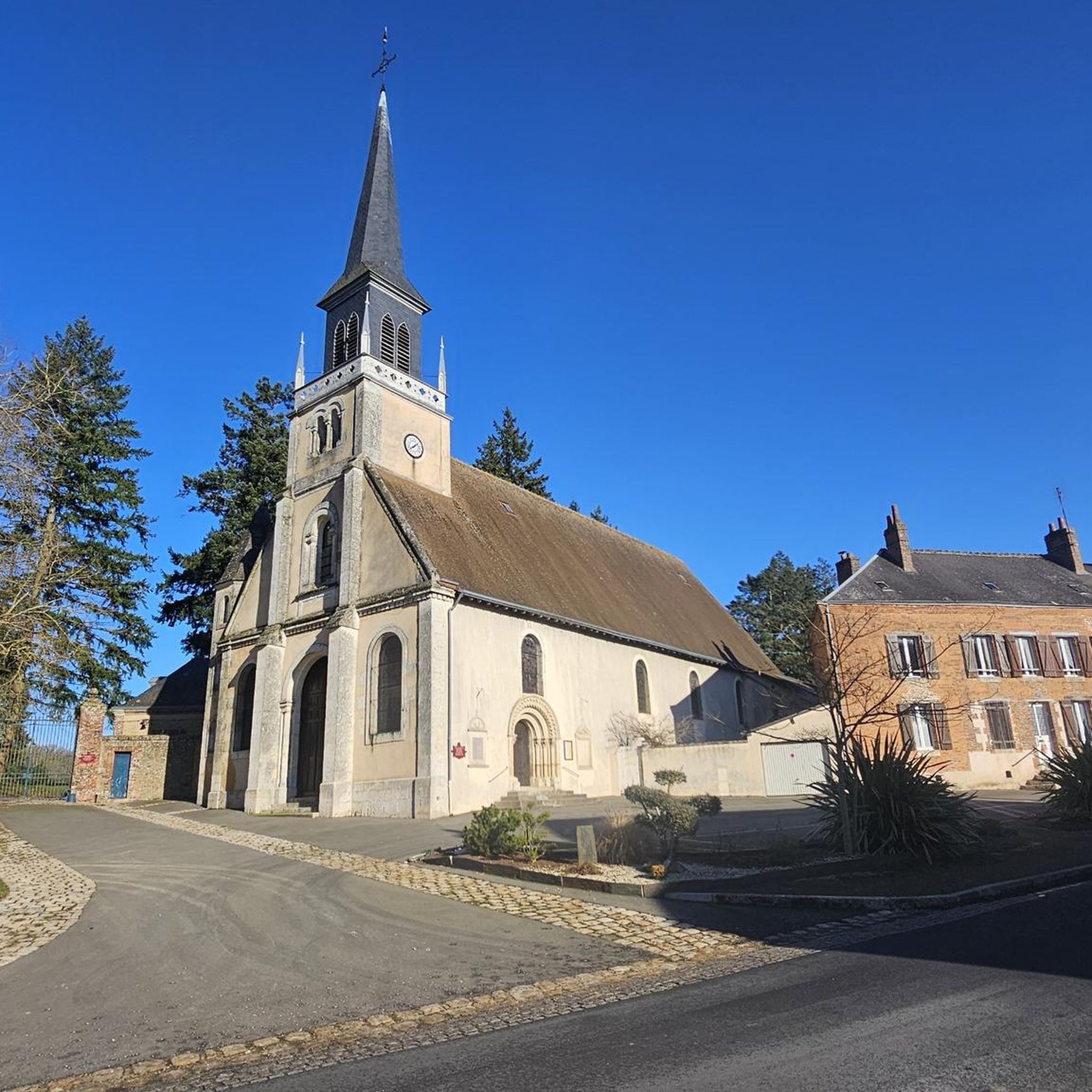
The 12th century church of Saint Jean-Baptiste de Courtalain, already repaired in 1592, was rebuilt in 1809, increased by an aisle in 1838, then by a remarkable porch bell tower topped with a twelve meter spire. height, thanks to the generosity of the Montmorency family, owner of the castle. It is to Guillaume Davaugour and Perette de Baïf, his wife, that we attribute the erection of the Courtalain chapel into a parish church; The church is located in the immediate perimeter of the castle. The entire building is partly covered with flat tiles for the roof of the nave, the bell tower, the staircase turret; the three cut sides of the apse and the lower north side are covered in natural slate. Inside the nave is a Mutin Cavaillé Coll organ dating from 1936. It contains several interesting paintings.
0
0
The parish church of Saint-Pellerin, whose oriented plan is reduced to a simple rectangle, only retains a few vestiges of the Romanesque period: part of the southern wall, itself repaired several times. The building, which was struck by lightning, was restored in 1821 with the reconstruction of a beautiful molded frame with tie beams. On the north side a chapel opens onto the nave through two arcades which rest on cylindrical columns. The flat bedside is pierced by a large window with three lancets topped with flamboyant tracery. The western facade is dominated by a triangular gable whose slopes are decorated with kale and dogs sitting on piles of loads, the Renaissance style portal is decorated with a large shell surmounted by a sculpted base of a angel holding a shield. On the north and south sides, thick glaciated buttresses support the gutter walls. The Safeguarding of French Art granted aid of 25,000 F in 1993 to restore the flat tile roof and the slate bell tower.
0
0
The Langey church, built under the name of Saint Pierre, dates back to the 11th century. This rectangular building, without side aisles, 32m50 long and 8m80 wide, is finished on the west side by a gable with sloped cut stones, pierced by two pretty Romanesque windows, and on the east side by a semi-circular apse. Inside, it houses two polychrome wooden statues representing a 17th century bishop and Saint James. The octagonal bell tower, straddling the roof, is a frame resting on six posts and covered with slates. Its spire is certainly the most beautiful and highest in the region. The bell was cast on site, in the village itself in 1811.
0
0
Before the 13th century there were two parishes, Saint-Sauveur and Saint-Gilles, in 1300 the bishop of Chartres united them into one by a charter of Berchères, because of the smallness of the two parishes. The church dates from the beginning of the 17th century. Rebuilt on the foundations of an old Romanesque church, its originality comes from its bell tower with saddle roof, its caquetoire and its paneled vault redone in 2003. At the initiative of the Prince Duke of Montmorency-Laval, it has contained the reliquary of Sainte-Félicité since 1838. Saint Félicité, whose relics are in Montigny-le-Gannelon, is a martyr whose life is unknown, whose body was taken from the sacred cemeteries of Rome. We have his body, the skull, the bones of his arms, fingers and feet. They were removed from the Saint-Cyriaque cemetery in 1828 and placed in their respective places on a body artistically modeled in wax and measuring more than 1.40 meters in length. A magnificent chase, of the shape and size of an altar tomb, all furnished with glazing and embellished with gilding received this precious deposit. Pope Leo XII donated it to the Duke of Laval, then Charles X's ambassador to Rome. On his death, he bequeathed it by will to the church of Montigny-le-Gannelon where the old historic castle of Laval-Montmorency is located. The venerated hunt is now placed under the main altar of which it forms the tomb.
0
0


The church of Saint-Sauveur-Saint-Gilles and the castle of Montigny-le-Gannelon Montigny-le-Gannelon are wonderful. You just have to go over the mountain. Montigny-le-Gannelon Castle dates from the Renaissance period; it was redesigned during the course of a restoration in the 19th century Neo-Gothic.
1
0
코트레인 주변에서 가장 인기 있는 경로


더 살펴보기
찾고 있는 하이라이트를 아직 못 찾으셨나요? 다른 지역의 주요 명소 가이드를 확인해보세요:
