19의 아루가지 명소 & 주요 장소
아루에는 둘러볼 만한 장소가 많답니다. 하이킹 또는 사이클링을 좋아한다면 아루에 숨겨진 19
가지 보석을 만날 수 있을 거예요. 이 지역의 주요 명소를 살펴보면서 다음 모험을 계획해보세요.
마지막 업데이트: 10월 18, 2026
샤토 드 몽티니-르-가넬롱
하이라이트 • 성
Montigny-le-Gannelon Castle dates from the Renaissance period; it was redesigned …
번역자 Google •
팁에 의해

샤펠-기욤 노트르담 교회
하이라이트 • 종교적 장소
번역자 Google •
팁에 의해

이런 장소를 발견하려면 지금 가입하세요
최고의 싱글 트랙, 봉우리 및 다양한 흥미로운 야외 장소에 대한 추천을 받아보세요.
예브르 노트르담 성당
하이라이트 • 종교적 장소
The vault of the vast nave is paneled …
번역자 Google •
팁에 의해
오늘 무료 계정으로 시작하세요
다음 모험이 기다리고 있어요.



커뮤니티 팁

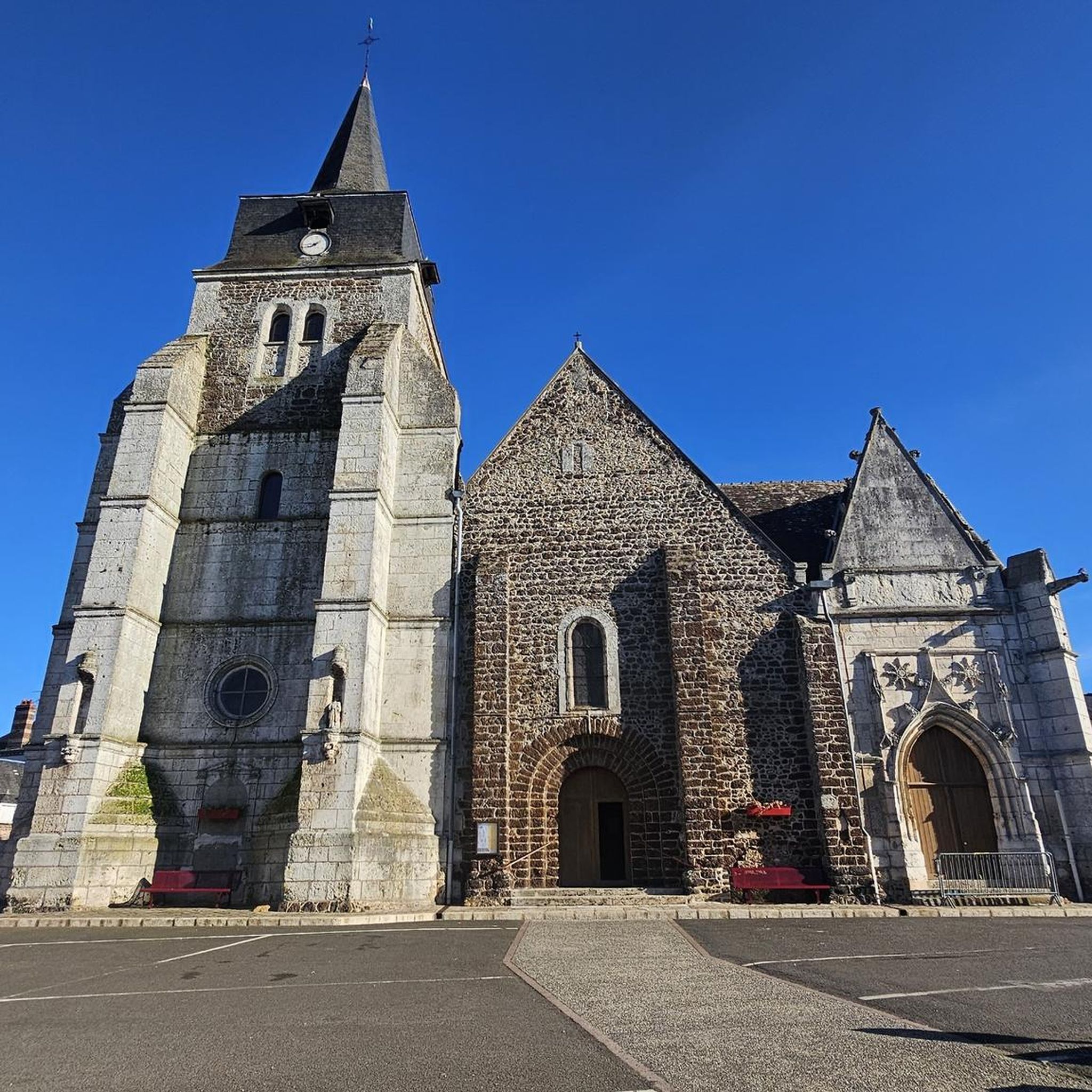
Placed under the patronage of Saint Hilaire, this parish was given by Gannelon de Montigny, lord of the place, to the abbey of Marmoutier around 1042. Its reconstruction probably dates from this period; it then became a priory. The church has a rectangular nave ending in a choir with a flat chevet. An examination of the masonry easily reveals two distinct periods of construction: the Romanesque period and the Renaissance. Built of flint rubble with rendering, the western part of the building appears to date from the 11th or 12th century. A limestone cornice supported by rather crude corbels underlines the base of the roof. To the south, two narrow Romanesque windows flared inwards light the nave. To the north, the bays were later reworked and enlarged. On this same side, a Romanesque doorway was walled up; It allowed the church to connect with a building whose traces of detachment remain. The bell tower was built to the north of the Romanesque nave, extending the western façade. The absence of a connection between the east and west walls of the bell tower and the north wall of the nave clearly indicates that it is an entirely later construction. However, its crowning is much later, as evidenced by its cornice, whose molding is in the classical style. Flanked by obliquely angled buttresses, it is covered with a saddleback roof. The eastern half of the church appears to be an extension built during the Renaissance period. Its ogee-shaped cornice and the decoration of the eastern gable, as well as the moldings of the buttress bands, attest to this dating. A vast rectangular choir then appears to have replaced a semicircular Romanesque apse; the eastern gable and the southern and northern façades were then pierced with networked bays. In the lower part of the north façade, projecting ashlars appear to have supported the roof of a lean-to building. To the south, a sacristy was built in the 19th century. Inside, the entire building is covered with a paneled vault with exposed tie beams and kingposts. The 18th-century high altar is surmounted by an Assumption of the Virgin inspired by Murillo's. For the restoration of the roofs and façades, the Sauvegarde de l'Art Français (French National Art Protection Agency) awarded a grant of €30,490 in 2001.
0
0
Building from the 12th, 15th and 17th centuries, remarkable from a distance with its bell tower whose spire soars 52 m high. The vault of the vast nave is paneled in Norwegian fir. The Renaissance entrance door is topped with a double pediment. The church has 17th century furniture of Breton inspiration, the sculptures of which are the work of the Breton Charles Roscouët. The baptismal font and the furniture of the sacristy are also worthy of interest. Relics of Saint-Constance, given to the church of Yèvres in 1678 by Lord Cyprien Besnard de Rezey, Advisor to the King and Intendant of Finances, with the approval of Mgr Ferdinand de Neufville de Villeroy, Bishop of Chartres, whose portrait is prominently placed in the nave of the church. The visit ends with the "chapier", a piece of furniture with semi-circular drawers, which contains, "flat", an exceptional collection of priestly vestments and accessories. Recent work on the south porch has revealed exterior fonts and attractive moldings on the pillars.
0
0
Before the 13th century there were two parishes, Saint-Sauveur and Saint-Gilles, in 1300 the bishop of Chartres united them into one by a charter of Berchères, because of the smallness of the two parishes. The church dates from the beginning of the 17th century. Rebuilt on the foundations of an old Romanesque church, its originality comes from its bell tower with saddle roof, its caquetoire and its paneled vault redone in 2003. At the initiative of the Prince Duke of Montmorency-Laval, it has contained the reliquary of Sainte-Félicité since 1838. Saint Félicité, whose relics are in Montigny-le-Gannelon, is a martyr whose life is unknown, whose body was taken from the sacred cemeteries of Rome. We have his body, the skull, the bones of his arms, fingers and feet. They were removed from the Saint-Cyriaque cemetery in 1828 and placed in their respective places on a body artistically modeled in wax and measuring more than 1.40 meters in length. A magnificent chase, of the shape and size of an altar tomb, all furnished with glazing and embellished with gilding received this precious deposit. Pope Leo XII donated it to the Duke of Laval, then Charles X's ambassador to Rome. On his death, he bequeathed it by will to the church of Montigny-le-Gannelon where the old historic castle of Laval-Montmorency is located. The venerated hunt is now placed under the main altar of which it forms the tomb.
0
0
This 13th, 15th and 16th century church does not have a transept. It has a central shingled nave with aisles. The choir ends with a polygonal apse. The apse is decorated with glass roofs dating from 1541 representing various scenes from the Passion. These 16th century stained glass windows (bays 1 to 4) have been partially classified as historic monuments since 1908. Bays 1 and 2 were restored in the 17th century thanks to the Bourbon-Conti family, lords of Bazoche-Gouet from 1676 in 1719, the 4 in the 19th century, then in 1974, by Michel Petit, master glassmaker whose workshop is located in Thivars in Eure-et-Loir. Outside the choir, the stained glass windows are from the 19th century, made by two renowned master glassmakers, the Lorin workshops in Chartres and the Carmel stained glass factory in Le Mans, the first in a neo-Romanesque style, the second approaching the neo-Romanesque style. Gothic.
0
0
The robust grison pillars of the church of Chapelle-Guillaume reveal its distant roots in the beautiful country of Perche-Gouët, and even if it is often difficult to fix with precision the date of construction of a church, at least It seems obvious to her that she has been watching over the small village that surrounds her for many centuries – probably not far from ten… It owes her name to Guillaume Gouët. In any case, the last two hundred years have given it many alterations and restorations. Thus the bell tower that a hurricane had brought down was rebuilt in 1827, while the capital which adorned the entrance disappeared a few decades later, serving as a narthex, or more simply as a “caquetoire”. Everything here announces the joy of welcome and the simple peace that a place of prayer requires. The interior is distinguished by the great care taken in maintaining the warm furnishings: painted vault, gallery, benches, paneling, statues and choir woodwork. The altarpiece is illustrated by a pretty painting of the Annunciation. A great harmony emerges from the whole and invites prayer. There was also not far from there near the church a Notre-Dame priory dependent on Marmoutier, where Saint Martin resided.
0
0


The church of Saint-Sauveur-Saint-Gilles and the castle of Montigny-le-Gannelon Montigny-le-Gannelon are wonderful. You just have to go over the mountain. Montigny-le-Gannelon Castle dates from the Renaissance period; it was redesigned during the course of a restoration in the 19th century Neo-Gothic.
1
0


