홀츠비크데에서 가장 멋진 20개의 동굴
성을 방문하는 건 언제나 특별한 일이에요. 하이킹을 하다가 잠깐 들를 때도, 가이드를 따라 제대로 둘러볼 때도 말이죠. 홀츠비크데에 있는 아름다운 성 20
곳을 아래에서 살펴본 후에 마음에 드는 성을 다음 모험 때 만나보세요!
마지막 업데이트: 5월 25, 2026
하우스 로덴베르크 수성
하이라이트 • 성
The bell tower tackles the quality time 🔔 🏰⛲️🏞
번역자 Google •
팁에 의해

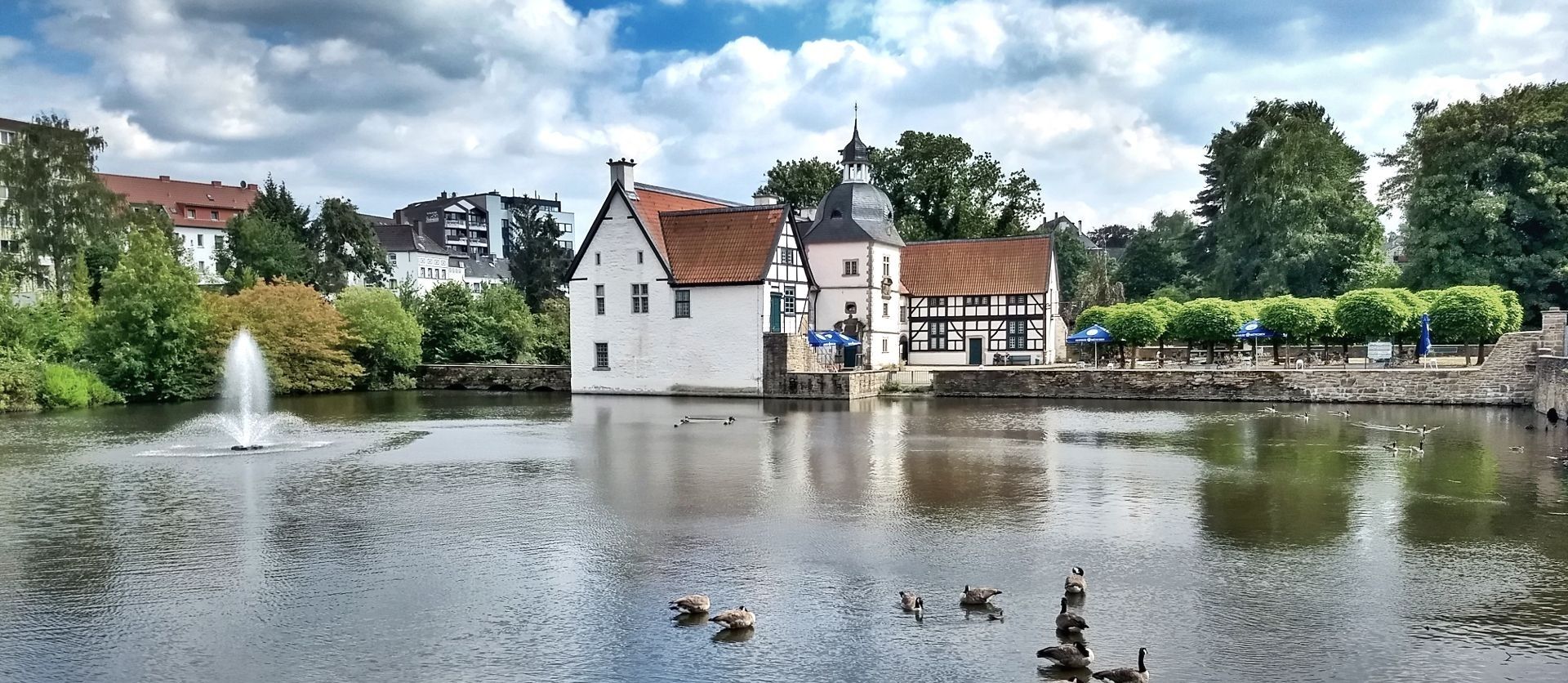
바서슐로스 하우스 오페르디케
하이라이트 • 성
이런 장소를 발견하려면 지금 가입하세요
최고의 싱글 트랙, 봉우리 및 다양한 흥미로운 야외 장소에 대한 추천을 받아보세요.
무료 회원 가입

후센 성과 식물 산책로
하이라이트 • 성
DO-6
House Husen
The manor of the Lords of Hüsen was first mentioned in 1259. Around 1330, Johann von der Husen was named as the feudal bearer …
번역자 Google •
팁에 의해





커뮤니티 팁

"History: Husen House is located in what is now the Syburg district of Dortmund, in the south of the city. It lies below the Syberg hill, "on a gentle slope leading to the north bank of the Ruhr River." This location was likely chosen for strategic reasons. Husen House could maintain a fire signal connection with both Hohensyburg Castle and Ruhr Castle, thus allowing for early warning and repelling of potential attacks. The proximity of the navigable Ruhr River was also likely a decisive factor influencing the choice of building site. Husen House is the ancestral home of the Lords of Husen, who were first mentioned in 1259. The building that stands today is the former medieval residential tower, which was rebuilt in its current form in the 17th century. It is assumed that the original structure dates back to the 12th century. This is supported by the construction of the original building, which is based on the residential tower design typical of the 11th and 12th centuries. Husen House is the ancestral home of the Lords of Husen, who were first mentioned in 1259. The residential tower was built of Ruhr sandstone using rubble masonry. Originally, it consisted of two single-room residential floors surrounded by a wall approximately one meter thick. Husen House also had a two-aisled cellar. The fireplace, still extant today, on the south side of the tower was of central importance. It served both as a hearth and as a source of heat for the living quarters. In 1681, significant renovations were carried out on the residential tower. The year 1681, carved into the door jamb, commemorates these renovations. The few small windows were replaced with rectangular windows framed in sandstone. An external staircase now led directly to the entrance door on the east side of the tower. The southern part of the castle was extended with a smaller, single-story addition, which served as a stable and sleeping quarters for the servants. On the east side of the residential tower, a coat of arms is affixed to the cellar wall, commemorating the Barons von Romberg, successors of the Lords von Husen. The alterations made to the residential tower in 1681 still shape the building's exterior appearance today. Following interior renovations in the 1960s and late 1980s, Haus Husen has taken on its current form. https://vcp-westfalen.de/zeltplatz-haeuser/burg-husen/#geschichte
1
0

Hörde Castle, located in the Dortmund district of the same name, is a former moated castle whose origins date back to the 12th century. It sits on the shores of the artificially created Phoenix Lake 🌊, which was built to revitalize the disused Phoenix-Ost steelworks ⛓️. During World War II, Hörde Castle was partially destroyed and subsequently rebuilt. In 2001, the Phoenix-Ost plant ⛓️ was shut down, leading to the demolition of the production facilities. Starting in 2008, archaeological excavations were carried out on the grounds of Hörde Castle, followed by extensive roof and structural renovations. 📷 A great photo opportunity 📸
4
0

Husen Castle is a medieval residential tower in Dortmund-Syburg, North Rhine-Westphalia. The castle's origins date back to the 13th century, and its current form dates from the 17th century. The castle is a listed building and is now used by the Association of Christian Girl Scouts and Boy Scouts (VCP) in Westphalia as a center and youth camp site1. The castle grounds cover around 7,000 square meters and offer space for youth groups and events. There are bedrooms, a self-catering kitchen, day rooms and a large knights' hall with a fireplace. There is also a camp site with a fireplace and covered shelter. Source: KI
3
0


The excavations at Hörder Castle, carried out by Dortmund City Archeology between 2007 and 2009, uncovered extensive and significant archaeological traces that shed light on the castle's 800-year construction history. Particularly noteworthy is the discovery of a bastion from 1500, which indicates that the medieval castle complex was converted into an early modern fortress. These discoveries provide new insights into the military and administrative significance of Hörder Castle over the centuries.
4
0

The former aristocratic residence Haus Rodenberg in Dortmund-Aplerbeck originally emerged from a medieval moated castle on the banks of the Emscher and was mentioned in a document as early as 1290. Of the former gardens, only the outer bailey island, the surrounding moats, the house pond and remnants of the wall surrounding the main garden remain. Today the park area is a public green space in the center of the Aplerbeck district.
11
0

Heeren Castle can be rented for weddings and conferences. It is occupied by the owner family.
1
0

The current buildings were built as an outer bailey between 1920 and 1922 in the historicist style and served as the administration building for the steelworks. Hörde Castle and with it Ministeriale Albert I von Hörde are first mentioned in a document from Emperor Otto IV (HRR) in favor of the Corvey Monastery. The historically significant castle tower, which has been preserved to this day, dates from this period. After the decline of the steel industry on Phoenix East and the dismantling of the steelworks, a comprehensive renovation of the castle began in June 2008. After the excavations were completed in 2009, the numerous finds and some relics from the “Hoesch era” were exhibited on the ground floor of the castle building. The former Hoesch administration with the extension buildings is listed as an architectural monument, and the traces of the medieval castle are registered as an archaeological monument in the city of Dortmund's list of monuments.
4
0


