サン・トゥアン=シュル=イトンのおすすめライド
4.6
(16)
400
ライダー
119
ライド
サン・トゥアン=シュル=イトン周辺のロードバイクルートをお探しですか?ここでは、komootが提供するサン・トゥアン=シュル=イトンでのロードバイクライドのコレクション全体を評価して選び抜いた人気ルートをご紹介します。各ライドの詳細をぜひご覧ください。
最終更新日: 8月 25, 2026
4
ライダー
56.3km
02:37
220m
220m
中程度のロードライド. ある程度のフィットネスレベルが必要です。 全般的に舗装状態が良好で走行しやすい道です。
4
ライダー
33.1km
01:23
110m
110m
初級者向けロードバイクライド. あらゆるフィットネスレベルに適しています。 全般的に舗装状態が良好で走行しやすい道です。

無料新規登録
7
ライダー
52.7km
02:20
200m
200m
中程度のロードライド. ある程度のフィットネスレベルが必要です。 全般的に舗装状態が良好で走行しやすい道です。
3
ライダー
35.7km
01:31
230m
230m
初級者向けロードバイクライド. あらゆるフィットネスレベルに適しています。 全般的に舗装状態が良好で走行しやすい道です。
5
ライダー
35.7km
01:37
160m
160m
中程度のロードライド. あらゆるフィットネスレベルに適しています。 ツアーの一部に、未舗装のため走行が難しい箇所があるかもしれません。
さらに多くのルートや他のユーザーのおすすめ情報を確認できます。
無料新規登録
すでにアカウントをお持ちですか?
おすすめのツアーは他のkomootユーザーが実際に経験した何千ものアクティビティに基づいています。
無料アカウントで今日から始めよう
次の冒険が待っています。
ログインまたは登録




コミュニティからのヒント

Since 1823, the commune's territory has united the former parish of La Trinité, which was under the bishopric of Chartres, and that of Beaulieu, under the bishopric of Evreux, located on either side of the Avre River, which marked the separation. The tall brick bell tower-porch was added in the 19th century to the older nave (15th-16th centuries?), rectangular in plan, whose wooden vault rests on an exposed roof frame. This modest rural church houses, as a counterpart to the Curé d'Ars, a 15th-century polychrome stone Virgin of exceptional artistic quality. The two sculpted doors of the sacristy come from La Trinité, as well as the engraved "flat tomb" attached to the nave wall. It dates from the 15th century. and the inscriptions are difficult to decipher: Jean Fillon, wearing a canon's hood and a chasuble, his hands clasped and his feet resting on two small dogs, is depicted in a Gothic setting with two angels, silhouettes of altar boys, and canons. Near the baptismal font decorated with three fleurs-de-lis is a large painting of Saint Gilles the hermit, with the doe lying at his feet. A beautiful series of stained-glass windows from the early 20th century illustrate scenes from the New Testament, and two others show Joan of Arc at the king's coronation in Reims, then taking communion in her prison before being led to the stake.
0
0
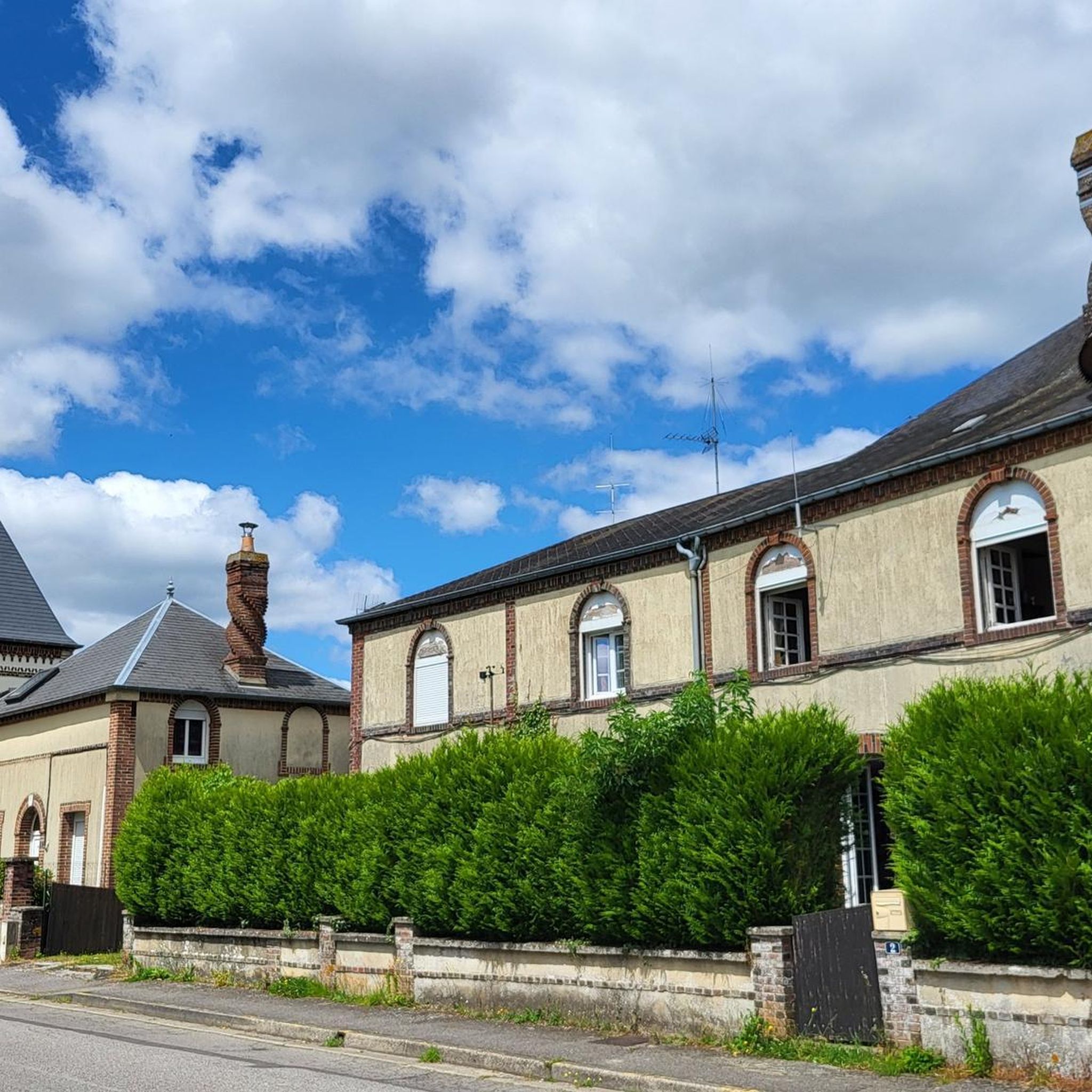
The church is closely inserted between the castle park and the houses of the village, which presents a harmonious ensemble of buildings from the 18th and early 19th centuries, combining flint and brick with lime plaster tinted with ochre. You have to step back a little to see its apse, the foundation of which probably dates back to the Romanesque period. Next to the entrance gable, dressed in Grison rubble, the bell tower was built in 1867 (according to the inscription preserving the names of the mason Gelin and the carpenter Hallier, with those of the priest, Abbot Porcher, the mayor, Viscount des Brosses, and the municipal councilors). The nave is extended by a rounded apse, with thick walls pierced by widely splayed semicircular openings, between which are placed the statues of Saint Sebastian, the Virgin and Child, Saint Michael and the dragon, and a holy bishop. On the "perque" (or beam of glory), a large Christ surrounded by the Virgin and Saint John. The transverse chapel, on the right, from the 15th or 16th century, vaulted with ribs resting on four pendentives with a central key carved like lace, was the seat of the brotherhoods. It houses the more recent statues of Saint Sebastian, the Virgin, Saint Michael and a holy bishop. The seigneury of Chennebrun, which belonged successively to Saint-Simon de Courtomer (1650), Caumont de la Force (1670), Grimoard de Beauvoir (1688), Laval Montmorency (1714), d'Espinay Saint-Luc (1765), etc., was acquired during the Restoration by Jacques-Alexandre Giroult des Brosses, whose father had been mayor of Dreux in 1771. In the seigneurial chapel on the left, inscriptions recall the names and dates of the members of this family linked for more than four generations to the life of the commune. We are grateful to them for having admirably maintained the castle, whose 18th century façade and the entrance to the park are visible from the gate. Their coat of arms appears on the stained glass window of this chapel, where we recognize in the center those of a Laval-Montmorency, Lord of Chennebrun, knight of honor of the Duchess of Orléans, master of the cavalry camp, who died in 1757, as indicated by his funerary slab on the threshold. The numerous 19th century stained glass windows with the names of the donors are worth seeing in detail. The one in the center, in the choir, lifts us to the sky with Our Lady of the Assumption. The statue of Mary, patron saint of Chennebrun, never ceases to watch over her church.
0
0
The church of Cintray has been listed as a historical monument since June 15, 1920. This building contributes to the beauty of the Eure landscapes and the richness of France's heritage. Over the centuries, the buildings that have been grafted or agglomerated in the surrounding area have been built within the framework of a social structure: the parish. These buildings constitute references in terms of local architecture, because they are often made with local materials: tiles or slates (from the 19th century), stones (flint, Grison, Seine Valley, sandstone, etc.), bricks or cob, lime plaster and nearby sand or earth. This gives colors that often range from beige to brown or red, and volumes perfectly suited to the Normandy climate (roof slopes, etc.). These churches have been the subject of specific analysis because their surroundings are not completely urbanized. The empty spaces or breathing spaces nearby help preserve their setting. The site of the church is very interesting because, located between the Iton and the very refined village square, it offers, to the south, large visual openings onto the monument. These spaces, little or not urbanized, must be preserved.
0
0

Right next to the town hall, the ideal place for a break
0
0

Located in the center of the village, it is dedicated to two twin brothers, Saint Gervais and Saint Protais, who were martyred in the 2nd century in Milan. Its construction dates from the 12th century. At that time, it included the flat-saddle nave and the choir. In the 15th and 16th centuries, it was completed by the south aisle and the ceiling covering. The south aisle was listed in July 1932, and the entire church has been listed since September 2011.
0
0

A beautiful church to visit.
0
0
サン・トゥアン=シュル=イトンでのの人気観光スポット

komootモバイルアプリでインスピレーションを得よう


さらに探索
他の地域の最高のロードサイクリングルートを見てみましょう。
