De beste turene og fjellturene rundt Coustouges
4,4
(656)
3 952
fjellvandrere
131
fjellturer
Vandring rundt Coustouges er en av de beste måtene å oppleve mer av landskapet på, selv om det ikke alltid er lett å finne den rette ruten. For å hjelpe deg har vi samlet de beste turene og fotturer rundt Coustouges — slik at du bare kan komme deg ut og gå.
Sist oppdatert: 26. november 2026
4,7
(6)
34
fjellvandrere
8,30km
02:41
330m
330m
Moderat fjelltur. God form kreves. Lettgåtte stier.
3,7
(7)
13
fjellvandrere
5,75km
01:35
90m
90m
Lett fjelltur. Lettgåtte stier.

4,8
(5)
10
fjellvandrere
14,2km
04:23
500m
500m
Moderat fjelltur. God form kreves. Lettgåtte stier.
4,5
(4)
11
fjellvandrere
3,40km
01:06
130m
130m
Lett fjelltur. Lettgåtte stier.
5,0
(4)
8
fjellvandrere
10,7km
03:26
430m
430m
Moderat fjelltur. God form kreves. Lettgåtte stier.
Få tilgang til flere ruter og anbefalinger fra andre utforskere.
Har du allerede en konto?
Ruteanbefalingene våre er basert på tusenvis av turer, sykkelturer og løp fullført av andre på komoot.
Start i dag med en gratis konto
Ditt neste eventyr venter.

Tips fra fellesskapet

Sant Cristòfol dels Horts is a church in the municipality of Els Horts, in the municipality of Albanyà, included in the Inventory of Architectural Heritage of Catalonia. It has been partially restored by the GAT of La Jonquera in recent times. The church of Sant Cristòfol dels Horts is very ruined. It consists of a single nave topped to the east by a semicircular apse. It presents construction elements from different periods. The western half, which seems to be the oldest, is the most damaged and has suffered various interventions. The rest of the nave preserves the vault, while the apse has a ruined roof and also part of the walls. The side walls are reinforced by buttresses on a slope. The differences in the construction system highlight the different periods in which the walls were built. In the western sector of the nave it presents a system of small ashlars of travertine limestone that corresponds to a late reconstruction. Little of the southern side wall has been preserved. The north wall has been well preserved and is covered by a slightly pointed vault. The structure is made of small ashlars and broken limestone slabs and could date from the 11th century. The rest of the church, the eastern section of the nave and the apse, was built with large, well-squared ashlars arranged in uniform rows, at an angle. This construction is typical of the late Romanesque period, 12th or 13th centuries. The apse opened onto the nave by a simple pointed arch and had an almond-shaped vault, which has not been preserved. On the southern wall there is a double-slanted semicircular arch window. At the bottom of the apse there were two that have disappeared. Sant Cristòfol dels Horts is the church of a scattered village of farmhouses, currently abandoned, located at the northern end of the municipality of Albanyà. The place of Horts is mentioned in the royal precept, favorable to Santa Maria d'Arles, of the year 878, in relation to some lands that were to belong to Sant Pere d'Albanyà. The parish does not appear mentioned until the year 954. The parish of Sant Cristòfol dels Horts depended, in the post-medieval period, on the churches of Fontfreda, Carbonils, els Vilars, Oliveda and the Sanctuary of Santa Maria del Fau. Source: https://ca.m.wikipedia.org/wiki/Sant_Crist%C3%B2fol_dels_Horts
0
0


Oak (Quercus ilex) next to the fountain of the old Bac hostel. Characteristics: This specimen has a barrel circumference of 3.30 m, the trunk is very rounded at the base, it is 6.30 meters in circumference and the maximum diameter is 1.20 m. The head is 15 m and rises up to 16 m. The spring that is next to the tree provides it with the necessary moisture for its growth. The trunk of the oak appears to be a regrowth from an older trunk. Condition: The trunk is bulging, it can be deduced that this tree has suffered from a lack of soil and the roots have had to make their way through the pumice stone. Suggestions: Very close to the source and this tree are the remains of L'hostal del Bac (17th century), frequented by porters who followed the St. Llorenç de Cerdans in Figueres.
1
0
The Teix del Fau (Taxus baccata) is a hundred-year-old specimen. The yew tree is a very slow-growing tree with millennial longevity. Characteristics: This specimen has a twisted trunk of a reddish color, it is about 2.60 m round and 8 meters high. The appearance of the tree is sudden and shows its velvety with a bark that is paraded. The diameter is 85 cm and the top, green and dense, is 7.50 m. Status: It is in a healthy state and, with so many years, its seeds have spread over the lap of the Fau, where many of its saplings are slowly growing. Suggestions: It should be borne in mind that both the roots and the leaves and branches contain a substance called taxine which is very poisonous.
0
0
Before reaching the Collada del Fau, if we come from the Castle of Bac de Grillera, we find a quite narrow gap with a path that goes inside and crosses it in its entirety. Inside the crack, almost reaching the end, and in its deepest part, the Pou del Fau begins by means of a ramp with a slight slope and covered by plant debris. At -7 meters a first well of -17 vertical meters begins, very narrow and with some small landing of clastic origin. At the eastern end of the lower floor, depth continues to be gained by another well with a -9 meter drop. From this point, exploration becomes impossible due to the narrowness of the duct. To visit its interior it is necessary to have the appropriate knowledge and equipment.
0
0
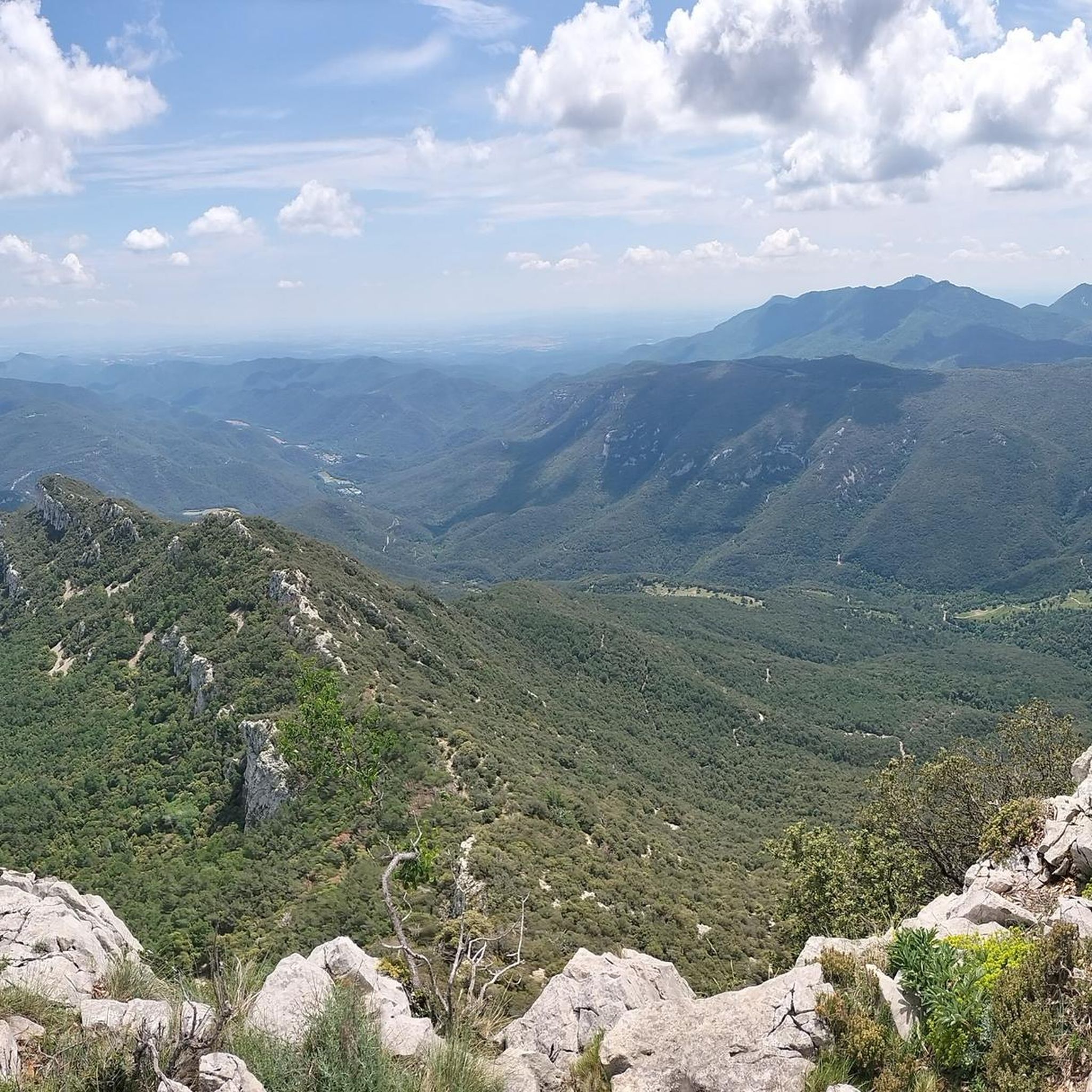
This mountain, at 1056 m, is the highest point of the Serra de Bac Grillera and is included in the list of 100 peaks of the F.E.E.C. We find a geodetic vertex of the National Geographic Institute and the Cartographic Institute of Catalonia. To the north we can enjoy good views of the Salines, the town of Tapis and Maçanet de Cabrenys in the background, while to the south we have the Serra del Mont and the Bassegoda.
0
0
It was the parish church of a village of scattered farmhouses, now abandoned, located in the northernmost part of the municipality, near the border. The place is mentioned in 878 and the parish (Sancti Cristophori de Ortis) in 954. It is in a sorry state that requires urgent consolidation of the remains, before the little that remains is damaged. It is a church with a single nave, topped with a semicircular apse and reinforced with buttresses. The part of the header is the best preserved. It is made of well-cut and good-sized ash trees. The vault is pointed, reinforced with two lateral arches, all work from the end of the 12th or beginning of the 13th century. The exterior facing is made of redstone ashlars, alternating with others of limestone. On the wall that closes the apse there are remains of painting from the Baroque period.
0
0
For many years the chapel of the Fau in the area of Albanyà has been largely forgotten in guides and monographs and has almost only appeared in glimpses in works of architectural heritage or cartography and that its cropped image is visible from far away. But the people of the towns of Albanyà, Maçanet; Sant Llorenç de La Muga; Costoja and Sant Llorenç de Cerdans, due to their proximity, devotion or tradition, keep beautiful memories. The Fau chapel is a nave with a semicircular apse. The nave was greatly reformed and extended in the 17th-18th centuries. The Romanesque apse is the only thing preserved from the primitive church of the 14th century, with a roof made of slate slabs from the country, without any windows, only a small square opening for ventilation. A few meters from the chapel on the south side is the hermit's house and inn with all the collapsed roofs. It consists of three bodies, the two in the southern part are the oldest and were the hermit's house. What remains closest to the chapel was the inn, there are the rooms, the kitchen and the dining room; and in the lower part the corral, the courts and the cellar; below the house there are three beams with dry wall of this farmhouse and it was supplied with water from a cistern close to the walls. There is also a modern utility room attached to the south wall. The house was inhabited until the middle of the 19th century. Work is now underway to adapt it as a mountain refuge. The Virge del Fau was also known as the Marsededéu de les Formigues or Alades, because on the day of her festival, September 8, thousands of winged ants go to die there. It is said that the phenomenon began at the beginning of the mass and increased considerably at the end of the service when the pavement and the surroundings of the chapel were covered with these small insects. It is said that attracted by the lights, the smell of the candles, the incense or the agglomeration of people, they rushed into the small temple, seeking death by suffocation, at the feet of the Virgin. The people of the village attributed it to a prodigy and some said that they came out of a hole on the Gesos side, called "the cistern hole"; and others that came from the tops of the nearby mountains. Carles Bosch de la Trinxeria, who knew these mountains very well, included the legend they had told him in his novel Lena (1894).
1
0
Mest populære ruter rundt Coustouges
Mest populære attraksjoner rundt Coustouges

Bli inspirert med komoot-appen


eller
Bli med i komoot nåUtforsk mer
Se gjennom de beste Fjellturer i andre regioner.
