하무아에서 가장 멋진 12개의 천연기념물
천연기념물을 방문하여 하무아의 아름다운 풍경을 만나보세요. 하무아에 있는 12
개의 천연기념물과 상세 정보를 살펴본 후에 방문하고 싶은 천연기념물을 다음 모험 계획에 추가해보세요!
마지막 업데이트: 6월 1, 2026

Inzéfond 채석장
하이라이트 • 구조물
번역자 Google •
팁에 의해

이런 장소를 발견하려면 지금 가입하세요
최고의 싱글 트랙, 봉우리 및 다양한 흥미로운 야외 장소에 대한 추천을 받아보세요.
무료 회원 가입
롱보 오동나무 십자가
하이라이트 • 기념물
A very old local tradition ensures that in clear …
번역자 Google •
팁에 의해

갤로우스 오크 (Chêne au Gibet)
하이라이트 • 자연 기념물
There is a plaque on it with a text about an old article. It would …
번역자 Google •
팁에 의해

오늘 무료 계정으로 시작하세요
다음 모험이 기다리고 있어요.
로그인 또는 가입하기


커뮤니티 팁

The Arville Cave is located near Arville Castle in Faulx-les-Tombes and consists of several smaller cavities collectively known as the "Arville Caves." The most famous cavity is the actual Arville Cave (also known as the Trou du Chantoir), which is located on the northern slope of a paleokarst depression. This depression has a nearly permanent pond at its bottom, the water level of which varies with the seasons. The caves are not open to the public or tourists. They are primarily an interesting karst area for geological and local nature walks.
4
0

The Ronvaux lime tree is located at one of the highest points of the Condroz, at an altitude of 340 meters. A very old local tradition ensures that in clear weather it can be seen from the top of the abbey towers of St. Hubertus. This large tree cross served as a religious landmark and marked a crossing point on the pilgrimage path to Saint-Hubert, the so-called Haut-Conduit, which crossed Ronvaux and Chevetogne to reach Saint-Hubert via Rochefort. Near the tree there is a sign with a text by E.H. Prosper Chalon, former abbot of Saint-Hubert. Thanks to his notes, Ciney's historical circle was able to trace the history of 21 crosses, including this one. Source: https://www.ciney.be/culture-et-loisirs/patrimoine/petit-patrimoine/les-arbres-remarquables
2
0

The Arville cave is a karst site made up of nine different caves aligned over around fifty meters. You can explore the Grotte d'Arville proper, a small cave about a hundred meters in size, or the Trou de la Gueule de Bois, a larger cave measuring 208 meters in diameter with some narrow passages. You can also enjoy the landscapes of Château d'Arville, a historic castle with a pond and park, or Bois d'Arville and Bois des Pauvres, two forests with hiking trails and diverse flora and fauna. The Grotte d'Arville is a hidden gem for caving enthusiasts and nature lovers.
6
1
The Chêne au Gibet is a remarkable and ancient oak tree which stands at the entrance to a forest near Barvaux-Condroz, Belgium. The tree is around 300 years old and its environment is classified as a historical heritage of Belgium. The oak tree has a circumference of 587 cm measured 1.5 m from the ground and is a majestic and impressive sight that attracts many visitors and trail runners.
2
0
Trou Mairiat is a former quarry located near the village of Custinne. It's a popular spot for hiking, horseback riding, and mountain biking, as it offers picturesque views of the hills and wooded valleys. A fun activity is to search for fossils of ancient sea creatures embedded in the limestone rocks along the path. These fossils date back to the Devonian period, about 400 million years ago, when this area was covered by a shallow sea. You can also appreciate the variety of flora and fauna that inhabit this region, such as wild orchids, butterflies, and birds of prey. Trou Mairiat is an ideal destination for nature lovers and history buffs.
2
0

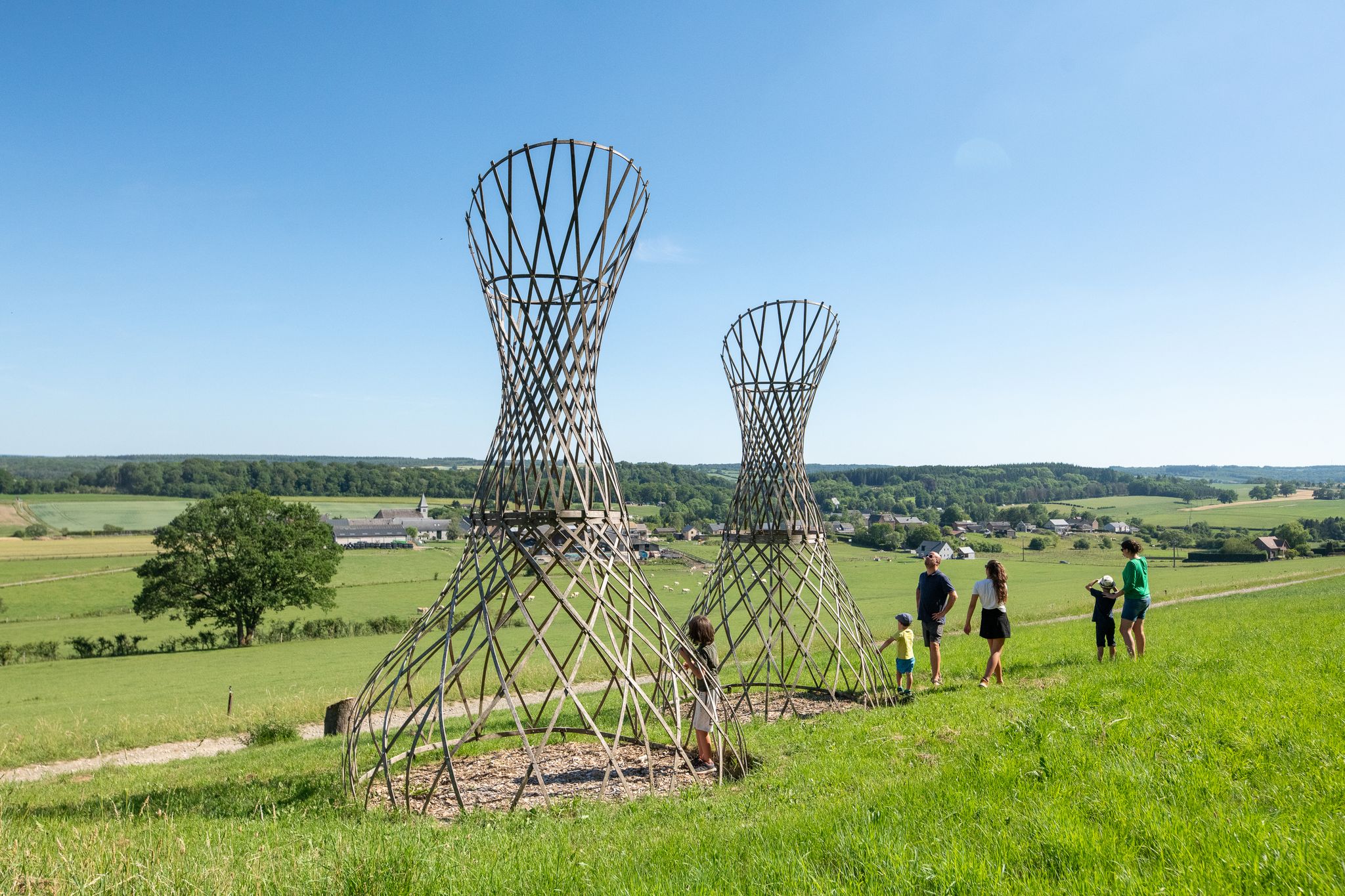
Opposite the quarry you will find an open lawn with a picnic area. The tables are large cut stone blocks. The area is fenced to keep wild boars at bay. At the beginning and end of the clearing there are two artificial poles: "Là où l'engoulevent se perche." (Where the nightjar resides).
10
0
This disused sandstone quarry, located in a fairly busy communal wood, includes a series of excavations dug in the right slope of the Samson valley and separated by slopes partly covered with dumps forming unstable scree in places. The rafts, partially used until 1997 for waste deposits, are currently being developed (educational and tourist purposes); a small pond was thus created on one of the riffles, fed by a seepage. The site, colonized by acid-loving vegetation, is especially interesting for the wet zone resulting from the main seepage, with the presence of a few plants of Hypericum androsaemum.
10
0
Located near Arville Castle in Faulx-les-Tombes (commune of Gesves), this karst site known for a long time by SSN cavers was studied for the first time in 1985-86. Nine karst phenomena, aligned over around fifty meters, were inventoried there. All of the cavities have been included under the name “Arville caves”. However, it should be noted that physical communication between these various holes has not been established. To the West, a vast circular depression located at the edge of the path, known under the (incorrect!) name of Arville chantoir, has all the characteristics of a paleokarst emptied by human activity. The bottom is occupied by an almost permanent pond whose level varies with the seasons. On its northern slope there is a small cavity about a hundred meters wide, the Arville cave itself (or Trou du Chantoir). Towards the east, a series of small holes which look more like burrows than caves, all belong to the same system. Some of them are traversed by a very perceptible current of air. On January 2, 1986, Jean-Pierre Romain, accompanied by Christian Perret, widened a narrowing in one of the holes and progressed more than a hundred meters. Let's move on from the circumstances and hazards of this unblocking... The cave was named by its authors "the Hangover or January 2 hole"! Further east, a series of small impenetrable sinkholes completes the whole. In the deepest, a limestone outcrop is visible. https://blog.ssn-speleo-namur.be/les-grottes/topotheque/arville/
9
0


