Junça 최고의 라이딩 경로
5.0
(1)
80
자전거 타는 사람
9
라이딩
준사 주변의 로드 사이클링 코스는 완만한 언덕과 상당한 고도 변화를 특징으로 하는 다양한 지형을 제공합니다. 이 지역의 풍경에는 역사 유적지와 강 계곡이 포함되어 있어 라이딩에 다양한 배경을 선사합니다. 로드 사이클링 코스는 종종 문화적 랜드마크를 지나며 역사적 관심사와 야외 활동을 통합합니다. 지형은 적당한 오르막부터 더 어려운 코스까지 다양한 선택지를 제공합니다.
준사 주변 최고의 로드 사이클링 코스
- 가장 인기 있는 로드 사이클링 코스는 알메이다 성 – 알메이다 출발 카스텔루 로드리고 마을 루프로, 29.8마일(48.0km) 길이이며 완료하는 데 2시간 11분이 걸립니다. 이 적당한…
마지막 업데이트: 10월 14, 2026
19
자전거 타는 사람
88.5km
03:53
760m
760m
보통 도로 자전거 타기. 좋은 체력 필요. 지면 대부분이 잘 포장되어 있고 라이딩하기 쉬움.
15
자전거 타는 사람
48.0km
02:12
490m
490m
보통 도로 자전거 타기. 좋은 체력 필요. 지면 대부분이 잘 포장되어 있고 라이딩하기 쉬움.

5.0
(1)
8
자전거 타는 사람
51.5km
02:37
690m
700m
보통 도로 자전거 타기. 좋은 체력 필요. 투어 중 라이딩하기 어려운 비포장 구간이 있을 수 있음.
8
자전거 타는 사람
79.1km
03:37
880m
880m
보통 도로 자전거 타기. 좋은 체력 필요. 지면 대부분이 잘 포장되어 있고 라이딩하기 쉬움.
5
자전거 타는 사람
58.9km
02:58
840m
840m
보통 도로 자전거 타기. 좋은 체력 필요. 지면 대부분이 잘 포장되어 있고 라이딩하기 쉬움.
더 다양한 경로와 다른 탐험가들의 추천을 살펴보세요.
이미 komoot 계정이 있나요?
투어 추천은 다른 사람들이 komoot에서 완료한 수천 개의 활동을 바탕으로 구성되어 있습니다.
오늘 무료 계정으로 시작하세요
다음 모험이 기다리고 있어요.
Junça 주변 인기 장소
커뮤니티 팁

Castelo Rodrigo holds millennia of history, from Paleolithic and Roman remains to the Muslim presence in the castle. Conquered and reconquered between the 12th and 13th centuries, it became a town and municipality under King Alfonso IX of León and passed definitively to Portugal in 1297, when King Dinis rebuilt and repopulated the castle. Marked by wars, charters, and restorations, it welcomed pilgrims on their way to Santiago and remains today one of the twelve Historic Villages of Portugal.
3
0
At the entrance to Castelo Rodrigo, the Monastery of Santa Maria de Aguiar rises among chestnut trees, founded in 1174 by King Afonso Henriques and handed over to the Cistercian Order. From the sober church to the monks' quarters and the guesthouse loggia with its 1704 coat of arms, everything testifies to centuries of faith and hospitality for pilgrims to Santiago. Despite the damage caused by the French invasions and its abandonment in 1834, the monastery's former beauty remains intact.
2
0
Malpartida stands serenely on the border plain, preserving in its main church, with its romantic bell tower, the most visible trace of its memory. But the past here goes far beyond the stones: from the cave tombs of the Nave de Mouros to the ancient watchtower of the Restoration, from the echoes of the Castilian sack of 1762 to the fierce battle against the French in 1808. Even generals left their mark; Ney established his headquarters here, and Brenier boldly escaped the siege of Almeida. Malpartida is, therefore, a land where every stone tells of battles, losses, and exploits.
2
0
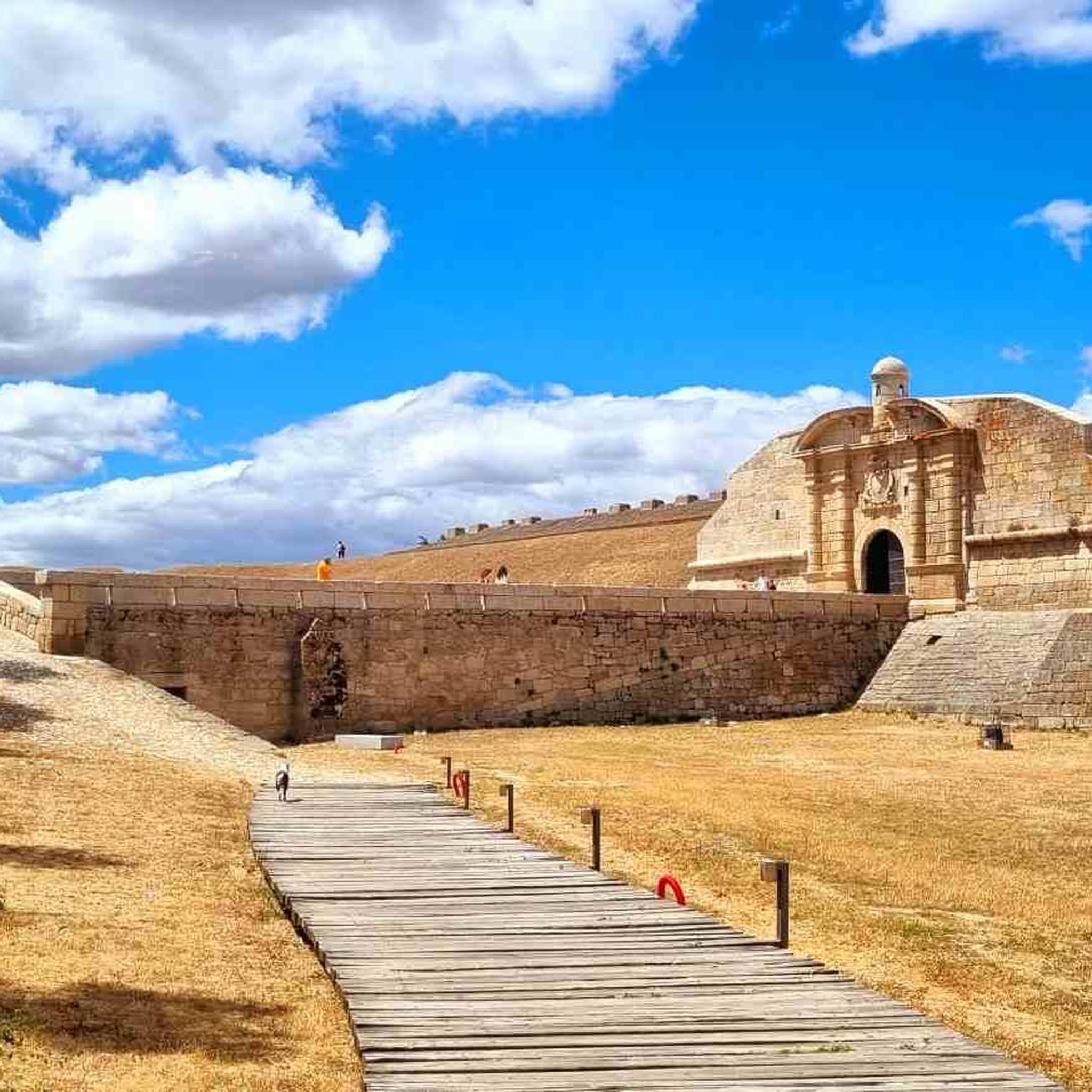
Almeida stands on the plateau like a table set for history: "Al-Mêda" was the name given to it by the Arabs. Previously, it had been a Lusitanian, Roman, and then Christian fort, conquered in 1190 and definitively Portuguese in 1297. Around the medieval castle grew the town, still marked by the Puerta do Sol. After the Restoration, the town transformed into a veritable war machine: the six-pointed star-shaped fortress, with bastions, ravelins, and underground galleries that served as both shelter and prison. It was the scene of decisive battles, devastated by the explosion of 1810 and contested in the liberal wars, always rising from the ruins.
3
0
For centuries, crossing the Côa Valley was only possible via two bridges: the São Roque Bridge and this one, the Ponte Grande, the gateway to Almeida. Built in the 17th century and renovated in the 19th century, the Ponte Grande was forever linked to the Battle of the Côa in 1810, when the Portuguese-British forces resisted the third Napoleonic invasion. Today, the bridge remains a silent guardian of that memory.
3
0
Castelo Mendo is a historic village with medieval roots, marked by two walls: the oldest, dating from the 12th century, surrounds the old town with its castle and the church of Santa Maria; the second, built by King Dinis in the 14th century, protected the Gothic suburb. The site was a living border between Portugal and León until the Treaty of Alcanices (1297), guarding strategic passages over the Côa River. At the entrance, two Vetón bellows, stone figures in the shape of wild boars, recall even more remote origins. Classified as a Property of Public Interest since 1984, Castelo Mendo today stands as a rare testament to the border region's history and Portuguese medieval splendor.
2
0
Freineda, a small border village, welcomed Lord Wellington between late 1812 and the spring of 1813, during the Peninsular War. In a stone house next to the church, the general established his headquarters, while the rest of the general staff dispersed to neighboring villages. Although described at the time as poverty-stricken, the village became the scene of major military decisions. Today, it remains modest and small, but keeps the memory of that time alive: on the facade of the house where Wellington lived, a plaque commemorates his visit.
2
0
Malhada Sorda, a name evoking ancient sheepfolds and shepherds' huts, was born from the transhumance of cattle across the border. In the heart of the village stands the Church of São Miguel, dating from the late 16th century, flanked by a bell tower that once served as a prison and whose bells still echo manually during processions. Another landmark is the so-called Esnoga or Clock House, a recently restored 17th-century building, which popular tradition suggests may have been a secret synagogue.
2
0
Junça에서 가장 인기 있는 경로
Junça에서 가장 인기 있는 명소


더 살펴보기
다른 지역의 최고의 로드 사이클링 경로를 살펴보세요.
