マルヴィル=ムーティエ=ブリュレのおすすめライド
4.3
(48)
401
ライダー
162
ライド
マルヴィル=ムーティエ=ブリュレ周辺のロードバイクルートをお探しですか?ここでは、komootが提供するマルヴィル=ムーティエ=ブリュレでのロードバイクライドのコレクション全体を評価して選び抜いた人気ルートをご紹介します。各ライドの詳細をぜひご覧ください。
最終更新日: 8月 26, 2026
7
ライダー
78.4km
03:13
420m
420m
中程度のロードライド. ある程度のフィットネスレベルが必要です。 全般的に舗装状態が良好で走行しやすい道です。
7
ライダー
43.6km
01:46
200m
200m
初級者向けロードバイクライド. あらゆるフィットネスレベルに適しています。 全般的に舗装状態が良好で走行しやすい道です。

無料新規登録
8
ライダー
101km
04:12
580m
580m
中程度のロードライド. ある程度のフィットネスレベルが必要です。 ツアーの一部に、未舗装のため走行が難しい箇所があるかもしれません。
8
ライダー
64.8km
02:37
300m
300m
中程度のロードライド. ある程度のフィットネスレベルが必要です。 全般的に舗装状態が良好で走行しやすい道です。
5
ライダー
96.9km
04:04
500m
500m
中程度のロードライド. ある程度のフィットネスレベルが必要です。 ツアーの一部に、未舗装のため走行が難しい箇所があるかもしれません。
さらに多くのルートや他のユーザーのおすすめ情報を確認できます。
無料新規登録
すでにアカウントをお持ちですか?
おすすめのツアーは他のkomootユーザーが実際に経験した何千ものアクティビティに基づいています。
無料アカウントで今日から始めよう
次の冒険が待っています。
ログインまたは登録




コミュニティからのヒント


The Moulin de Mormoulins is a watermill located on the Eure River in the hamlet of Mormoulins. This mill dates back to the 18th and 19th centuries and is a listed historical monument. You can admire the old stone building, the wooden wheel, and the canal that diverts water from the river as you pass in front of the mill. The mill is surrounded by green fields and trees, creating a peaceful and relaxing atmosphere.
0
0

Very beautiful pond
0
0

large bird reserve and nautical activities
0
0

The Saint-Rémy church in Saint-Rémy-sur-Avre is dedicated to Saint Remi of Reims, Bishop of Reims who baptized Clovis in 496 in the Notre-Dame Cathedral of Reims. In the 12th century, it marked the border between the Duchy of Normandy and the French royal domain on which Saint-Rémy-sur-Avre depends. It is a flamboyant Gothic church from the 15th century, probably rebuilt since we have mention of its existence since the end of the 11th century.
0
0
The construction could date back to the beginning of the 12th century. The nave ends with a chancel with a four-sided apse. A bell tower outside the work is located against the west wall. A seigneurial chapel was built to the north of the chancel. The study of the framework has made it possible to determine several construction phases: 1117-1190, 1274, 1487-1520. The interior walls retain a painted historiated decoration on the back of the west portal, probably representing a dance of death, which could date back to the 1500s. The large funeral chapel built between 1577 and 1585 probably goes back to the architect Métezeau. Its decoration is representative of the end of Mannerism and the Henri IV style. The stained glass windows were restored by the master glassmaker Raphaël Lardeur and were installed in 1947. Lardeur also created the mosaic Stations of the Cross.
0
0
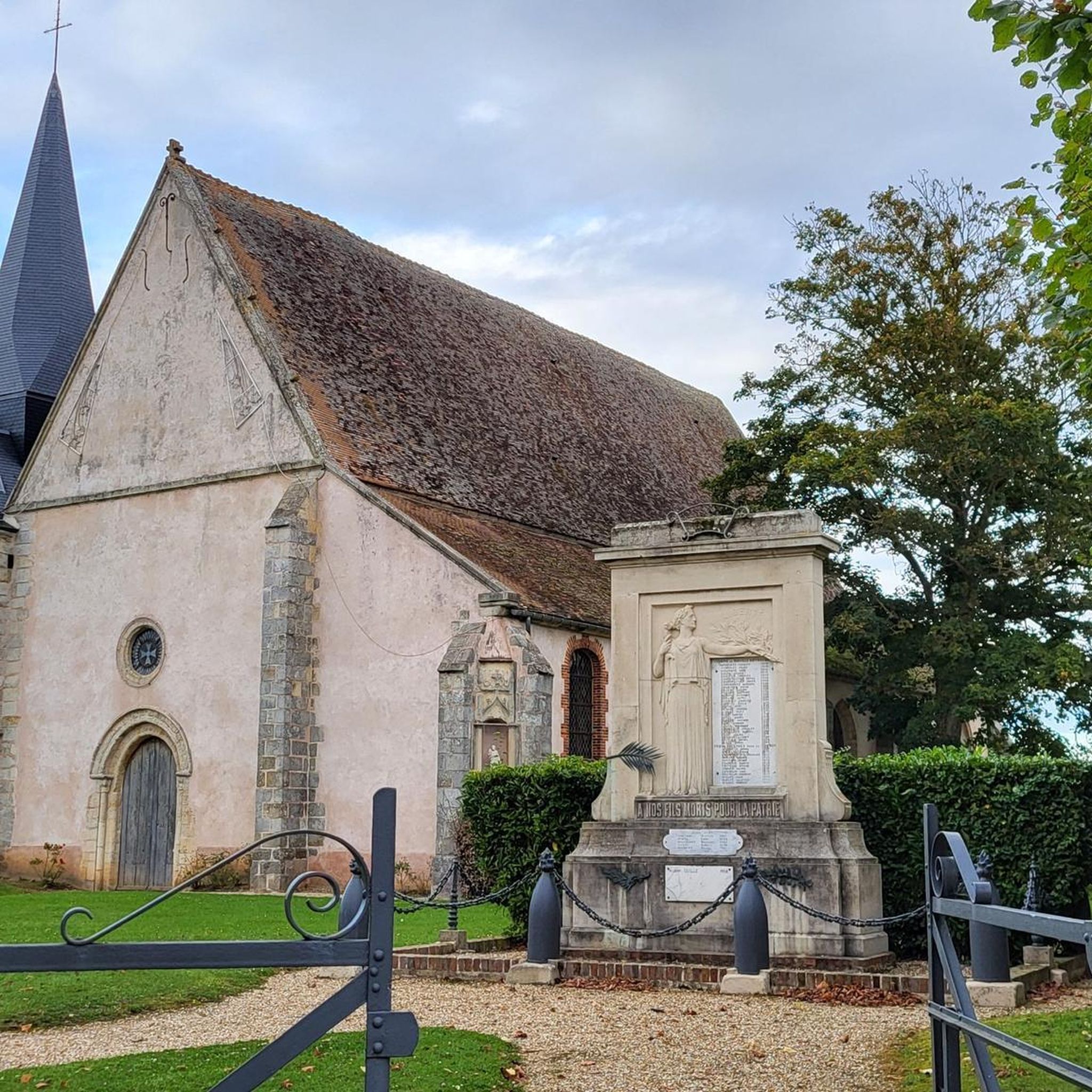
The parish church of Escorpain, dedicated to Saint Germain, is a very simple building, rectangular in plan and of modest dimensions. With a single nave, it ends with a flat chevet; a sacristy is attached to the north side of the choir; the gable wall of the façade is topped with a slate spire. The church is mentioned as early as the 12th century. The small rubble stonework, which also bears the traces of numerous alterations, and the small openings, three in number in the north wall and only one in the south wall, constitute the oldest remains of this building which was extensively restored in the 19th century. It was in fact from 1886, thanks to the generosity of the Firmin-Didot family that the building was raised, as evidenced by the gable wall of the façade. The nave was then covered with a panelled vault, replacing the previous framework: the 1886 inscription mentions previous work campaigns, in the 17th century in particular. The entire interior was redesigned, not without unity, in a neo-Gothic style. As for the two large bays in the south wall, probably pierced in the 16th century, they were greatly altered during this campaign. For the repair of the exterior masonry, the rendering of the façade, the roofs of the nave and a slope of the sacristy, the Sauvegarde de l’Art Français granted this unprotected church a subsidy of 80,000 F in 1994.
0
0
small church and its cemetery
0
0
マルヴィル=ムーティエ=ブリュレでのの人気観光スポット

komootモバイルアプリでインスピレーションを得よう


さらに探索
他の地域の最高のロードサイクリングルートを見てみましょう。
