Junçaのおすすめライド
5.0
(1)
80
ライダー
9
ライド
Junça周辺のロードサイクリングルートは、起伏のある丘陵地帯とかなりの高低差を特徴とする多様な地形をしています。この地域の景観には史跡や川沿いの谷が含まれており、サイクリングに多様な背景を提供します。ロードサイクリングルートは文化的なランドマークを通り過ぎることが多く、歴史的な興味とアウトドアアクティビティを統合しています。地形は、適度な登りからより挑戦的なルートまで、さまざまな選択肢を提供します。
Junça周辺のベストロードサイクリングルート
- 最も人気のあるロードサイクリングルートは、アルメイダ城 – アルメイダからのカステロ・ロドリゴ村ループで、距離は29.8マイル(48.0 km)、所要時間は2時間11分です。この適度なルートは、歴史的な村々と景色の良い道を結んでいます。
- 地元のロードサイクリストに人気のもう一つのルートは、カステロ・メンド歴史村 – ビラール・フォルモーゾからのビラール・フォルモーゾループで、適度な36.6マイル(58.9 km)のコースです。このルートは、地域の景観を通してかなりの高低差があります。
- 地元のロードサイクリストは、カステロ・ロドリゴ村 – アルメイダからのアルメイダ城ループも気に入っています。この46.8マイル(75.3 km)のルートは、歴史的な村々や広大な田園地帯を通り抜け、所要時間は約3時間44分です。
- Junça周辺のロードサイクリングは、歴史的なランドマーク、多様な地形、そして挑戦的な登りが特徴です。このネットワークは、簡単なループからかなりの高低差のあるより困難なルートまで、さまざまなレベルのサイクリストに選択肢を提供します。
- Junçaのルートは、komootコミュニティから5.0つ星中平均5.0つ星という高い評価を得ており、レビューは1件以上あります。70人以上のロードサイクリストがkomootを利用して、Junçaの多様な地形を探索しました。
最終更新日: 9月 17, 2026
19
ライダー
88.5km
03:53
760m
760m
中程度のロードライド. ある程度のフィットネスレベルが必要です。 全般的に舗装状態が良好で走行しやすい道です。
15
ライダー
48.0km
02:12
490m
490m
中程度のロードライド. ある程度のフィットネスレベルが必要です。 全般的に舗装状態が良好で走行しやすい道です。

5.0
(1)
8
ライダー
51.5km
02:37
690m
700m
中程度のロードライド. ある程度のフィットネスレベルが必要です。 ツアーの一部に、未舗装のため走行が難しい箇所があるかもしれません。
8
ライダー
79.1km
03:37
880m
880m
中程度のロードライド. ある程度のフィットネスレベルが必要です。 全般的に舗装状態が良好で走行しやすい道です。
5
ライダー
58.9km
02:58
840m
840m
中程度のロードライド. ある程度のフィットネスレベルが必要です。 全般的に舗装状態が良好で走行しやすい道です。
さらに多くのルートや他のユーザーのおすすめ情報を確認できます。
すでにアカウントをお持ちですか?
おすすめのツアーは他のkomootユーザーが実際に経験した何千ものアクティビティに基づいています。
無料アカウントで今日から始めよう
次の冒険が待っています。
Junça周辺で人気
コミュニティからのヒント

Castelo Rodrigo holds millennia of history, from Paleolithic and Roman remains to the Muslim presence in the castle. Conquered and reconquered between the 12th and 13th centuries, it became a town and municipality under King Alfonso IX of León and passed definitively to Portugal in 1297, when King Dinis rebuilt and repopulated the castle. Marked by wars, charters, and restorations, it welcomed pilgrims on their way to Santiago and remains today one of the twelve Historic Villages of Portugal.
3
0
At the entrance to Castelo Rodrigo, the Monastery of Santa Maria de Aguiar rises among chestnut trees, founded in 1174 by King Afonso Henriques and handed over to the Cistercian Order. From the sober church to the monks' quarters and the guesthouse loggia with its 1704 coat of arms, everything testifies to centuries of faith and hospitality for pilgrims to Santiago. Despite the damage caused by the French invasions and its abandonment in 1834, the monastery's former beauty remains intact.
2
0
Malpartida stands serenely on the border plain, preserving in its main church, with its romantic bell tower, the most visible trace of its memory. But the past here goes far beyond the stones: from the cave tombs of the Nave de Mouros to the ancient watchtower of the Restoration, from the echoes of the Castilian sack of 1762 to the fierce battle against the French in 1808. Even generals left their mark; Ney established his headquarters here, and Brenier boldly escaped the siege of Almeida. Malpartida is, therefore, a land where every stone tells of battles, losses, and exploits.
2
0
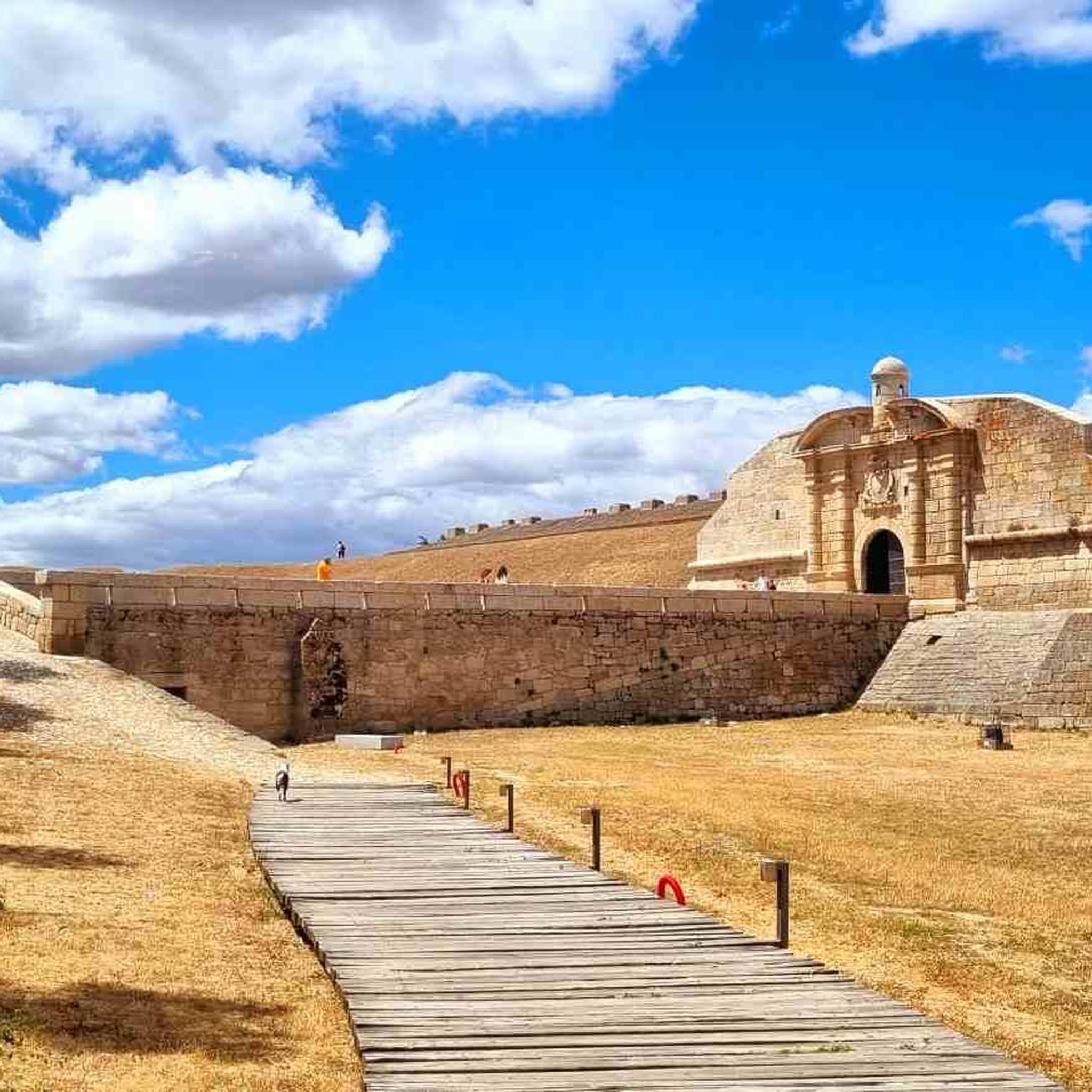
Almeida stands on the plateau like a table set for history: "Al-Mêda" was the name given to it by the Arabs. Previously, it had been a Lusitanian, Roman, and then Christian fort, conquered in 1190 and definitively Portuguese in 1297. Around the medieval castle grew the town, still marked by the Puerta do Sol. After the Restoration, the town transformed into a veritable war machine: the six-pointed star-shaped fortress, with bastions, ravelins, and underground galleries that served as both shelter and prison. It was the scene of decisive battles, devastated by the explosion of 1810 and contested in the liberal wars, always rising from the ruins.
3
0
For centuries, crossing the Côa Valley was only possible via two bridges: the São Roque Bridge and this one, the Ponte Grande, the gateway to Almeida. Built in the 17th century and renovated in the 19th century, the Ponte Grande was forever linked to the Battle of the Côa in 1810, when the Portuguese-British forces resisted the third Napoleonic invasion. Today, the bridge remains a silent guardian of that memory.
3
0
Castelo Mendo is a historic village with medieval roots, marked by two walls: the oldest, dating from the 12th century, surrounds the old town with its castle and the church of Santa Maria; the second, built by King Dinis in the 14th century, protected the Gothic suburb. The site was a living border between Portugal and León until the Treaty of Alcanices (1297), guarding strategic passages over the Côa River. At the entrance, two Vetón bellows, stone figures in the shape of wild boars, recall even more remote origins. Classified as a Property of Public Interest since 1984, Castelo Mendo today stands as a rare testament to the border region's history and Portuguese medieval splendor.
2
0
Freineda, a small border village, welcomed Lord Wellington between late 1812 and the spring of 1813, during the Peninsular War. In a stone house next to the church, the general established his headquarters, while the rest of the general staff dispersed to neighboring villages. Although described at the time as poverty-stricken, the village became the scene of major military decisions. Today, it remains modest and small, but keeps the memory of that time alive: on the facade of the house where Wellington lived, a plaque commemorates his visit.
2
0
Malhada Sorda, a name evoking ancient sheepfolds and shepherds' huts, was born from the transhumance of cattle across the border. In the heart of the village stands the Church of São Miguel, dating from the late 16th century, flanked by a bell tower that once served as a prison and whose bells still echo manually during processions. Another landmark is the so-called Esnoga or Clock House, a recently restored 17th-century building, which popular tradition suggests may have been a secret synagogue.
2
0
Junçaの人気ルート
Junçaの人気観光スポット

komootモバイルアプリでインスピレーションを得よう


さらに探索
他の地域の最高のロードサイクリングルートを見てみましょう。
