Αξιοθέατα και μέρη για επίσκεψη Tesson - Top 20
Υπάρχουν πολλά μέρη να δείτε και να επισκεφθείτε Tesson. Είτε αγαπάτε την πεζοπορία είτε την ποδηλασία, Tesson είναι μια περιοχή όπου 20
κρυμμένα στολίδια περιμένουν να ανακαλυφθούν. Δείτε τα καλύτερα αξιοθέατα της περιοχής και σχεδιάστε την επόμενη περιπέτειά σας σήμερα.
Τελευταία ενημέρωση: 9 Οκτωβρίου 2026
Église Saint-Martin
Highlight • Άλλο
Μετάφραση από Google •
Συμβουλή από

Donjon of Pons
Highlight • Κάστρο
Μετάφραση από Google •
Συμβουλή από

Εγγράψου τώρα για να ανακαλύψεις μέρη σαν αυτό
Λάβε προτάσεις για τα καλύτερα single tracks, κορυφές και πολλά ακόμα συναρπαστικά υπαίθρια μέρη.
On repère une église à son clocher,
Highlight • Άλλο
Μετάφραση από Google •
Συμβουλή από

Une crypte bâtie sur un ancien souterrain-refuge,
Highlight • Άλλο
Μετάφραση από Google •
Συμβουλή από
Église Saint-Pierre de Gémozac
Highlight • Θρησκευτικός χώρος
Μετάφραση από Google •
Συμβουλή από
Εγγράψου δωρεάν για να ανακαλύψεις ακόμα περισσότερα αξιοθέατα Tesson.
Έχεις ήδη λογαριασμό;
Ξεκίνα σήμερα με έναν δωρεάν λογαριασμό
Η επόμενη περιπέτειά σου σε περιμένει.




Συμβουλές από την κοινότητα

You can also spend a night at the Saint James House B&B, quality guest rooms, swimming pool and view of the Donjon 🙂
0
0

The keep of Pons is located in the commune of Pons in the French department of Charente-Maritime in the Nouvelle-Aquitaine region. This tower is the old keep of the castle of Pons. 33 m high, it is visible from a long distance and is the symbol of the city. With the Saint-Gilles chapel, the remains of the ramparts and the main building, it constitutes the remains of the ancient castle of Pons.
1
0

Of the first church built in the 12th century, only the apse, the transept, the Gothic chapels and the bell tower remain, which is one of the best preserved and most elegant in Saintonge. It rises on three square floors supported by a powerful stump, and each face is decorated with a slender arcade with five arches supported by columns with capitals. The upper floor is pierced on each side by three elegant semi-circular twin bays. Of the church, entrusted to the Chaise-Dieu Abbey in 1084 by Robert de Pons, only the eastern part remains, the nave having disappeared during the Wars of Religion (16th century). Inside, note the dome divided into eight compartments as well as very beautiful capitals in the original sanctuary, decorated with acanthus leaves and palmettes. An ossuary crypt, from the end of the 12th or beginning of the 13th century, located under the chapel, extends the northern arm of the transept. It is accessible by a small staircase. It is covered with a primitive ribbed cross. A stone bench goes around the crypt about 50 centimeters from the current floor. Open on request at the town hall.
0
0
Certain foundations of small elongated freestones bear witness to a building from the end of the 11th century or the beginning of the 12th century. The nave was taken over in the second half of the 12th century and reinforced by arcades. If the base of the bell tower is characteristic of Romanesque architecture, its upper part bears the mark of the first Gothic age. The octagonal stone spire crowns a bell chamber based on a similar plan, the sides featuring alternating single bays and twin bays. Finally, the north wall and the facade were redone in the 19th century, the first bay of the nave having been shortened in order to widen the road passing in front of the church41. Like the majority of churches in the region, the Saint-Pierre de Gémozac church is based on a plan in the shape of a Latin cross. It consists of a single nave with four bays covered with a pointed barrel vault, which was completely redone in the 16th century. Inside, arcades respond to the buttresses and serve to reinforce the structure of the building. As in some Romanesque churches in the region, the transepts are covered with cupolas. However, if the north brace has a dome on squinches, the south brace has the particularity of having a dome on pendentives. The two arms of the transept are extended by apsidioles: the oldest (12th century), that of the south transept, forms a vaulted hemicycle; the most recent is a rectangular chapel covered with ribbed vaults. A narrow arcade opens onto the first bay of the choir. This forms a set of two spans. The first is covered with quadripartite warheads, while the second is completed by liernes. The flat apse (13th century), pierced with a triplet, testifies to the Cistercian influence on the architecture of the time. The church of Saint-Pierre de Gémozac is part of the tourist inventory of the most beautiful churches of Saintonge and is often cited among the religious buildings worthy of a visit. In certain aspects, this church is indeed one of the beautiful Romanesque churches of the Saintonge type, among which are still the remarkable churches of Rétaud, Rioux or even Thaims, all located in its canton.
0
0

The Church of Saint-Martin de Coucoury was built around the 11th century. It is a pretty example of a Romanesque church.
1
0

For people with a head for heights, it is worth climbing the 30-metre-high tower. There is also a museum in the building. It is one of the 'Monument historique' in France.
0
0
This sanctuary undoubtedly had to suffer depredations during the various conflicts that bloodied Saintonge, as evidenced by the various reconstruction campaigns, which make the building a synthesis of Saintonge Romanesque and late Gothic styles. The watchtower and machicolations of the southern transept bear witness to the wars of religion, which were particularly violent in the region. A crypt built on an old underground refuge, perhaps of Celtic origin, was rediscovered in 1976. The complex architecture of the Saint-Martin church bears witness to numerous alterations over the centuries. The oldest parts of this former Casadean possession seem to date back to the 12th century, a period which saw the flowering of many Romanesque churches in the Saintonge countryside. The facade, high and slender, consists of two horizontal registers and is crowned with a sharp gable, which adds to its monumentality. The lower part consists of a single arched portal, with four bare arches (the keystones having been redone in 1895) supported by small columns with capitals decorated with interlacing, sculpted faces and birds drinking from the same chalice. , or on the contrary turning away from each other. The upper part is made up of a central bay with three arches, framed by two blind arcades, separated by a series of finely worked small columns mounted on a cornice and a fluted base and ending in candles. The transition between this floor and the gable is formed by a series of modillions representing animals whose names the sculptor transcribed into Latin on the edge of the tablets (Leopardus, Colube) as well as a curious character sticking out his tongue, illustration of the character willingly facetious of the "ymagiers" of the Middle Ages. The nave is made up of four bays, covered with a basket-handle vault. A series of columns with capitals devoid of any ornamentation once carried the beams supporting the primitive barrel vault, which has now disappeared. Ample broken barrel arcades punctuate its side elevations. Transept and choir have been considerably redesigned. If the structure of the transept and the primitive pre-choir are found again, with their Romanesque capitals and their barrel vaults, the whole has been "enveloped" by Gothic additions, forcing the masonry of this part of the building to be redone. church. In fact, the square of the transept has the particularity of being surrounded by dissimilar pillars, carrying roughly assembled arches. These transformations date from 1488, the year in which a report mentions the construction of "d'ung arseau soulz the tower of the bell tower of the said place". The vast Gothic sanctuary “doubles” the Romanesque parts. It is made up of a choir and two side chapels, all covered with ribbed vaults, which fall on culs-de-lampe representing enigmatic birds and human heads. Large ogival bays, where trilobes and quatrefoils mingle, flood this part of the building with light. A gilded wooden altarpiece, surrounded by two Louis XV style credenzas, take place in the choir and the adjacent chapels. The central motif is "The Lamb of the Apocalypse" caught in a radiant background. This set, restored by the Beaux-Arts in 1975, was designed for the Abbaye aux Dames de Saintes. The dome of the medieval extension of the crypt. The entrance to the crypt is at the foot of the high altar. The latter was rediscovered in 1976 by the priest at the time, D.Héraud. Entirely carved into the rock, it seems to have been built in the 5th century, perhaps on an underground refuge of Celtic origin. Enlarged in the 12th century, it served for a long time as an ossuary. Outside, the square bell tower rises at the crossroads of the transept, where a dome on pendentives has been fitted. Built in the 14th century, it is flanked by a "pine cone" staircase turret. Traces of fortifications (watchtower and battlements), but also of fire, testify to the fights of the wars of religion in the 16th century. Church open daily.
0
0
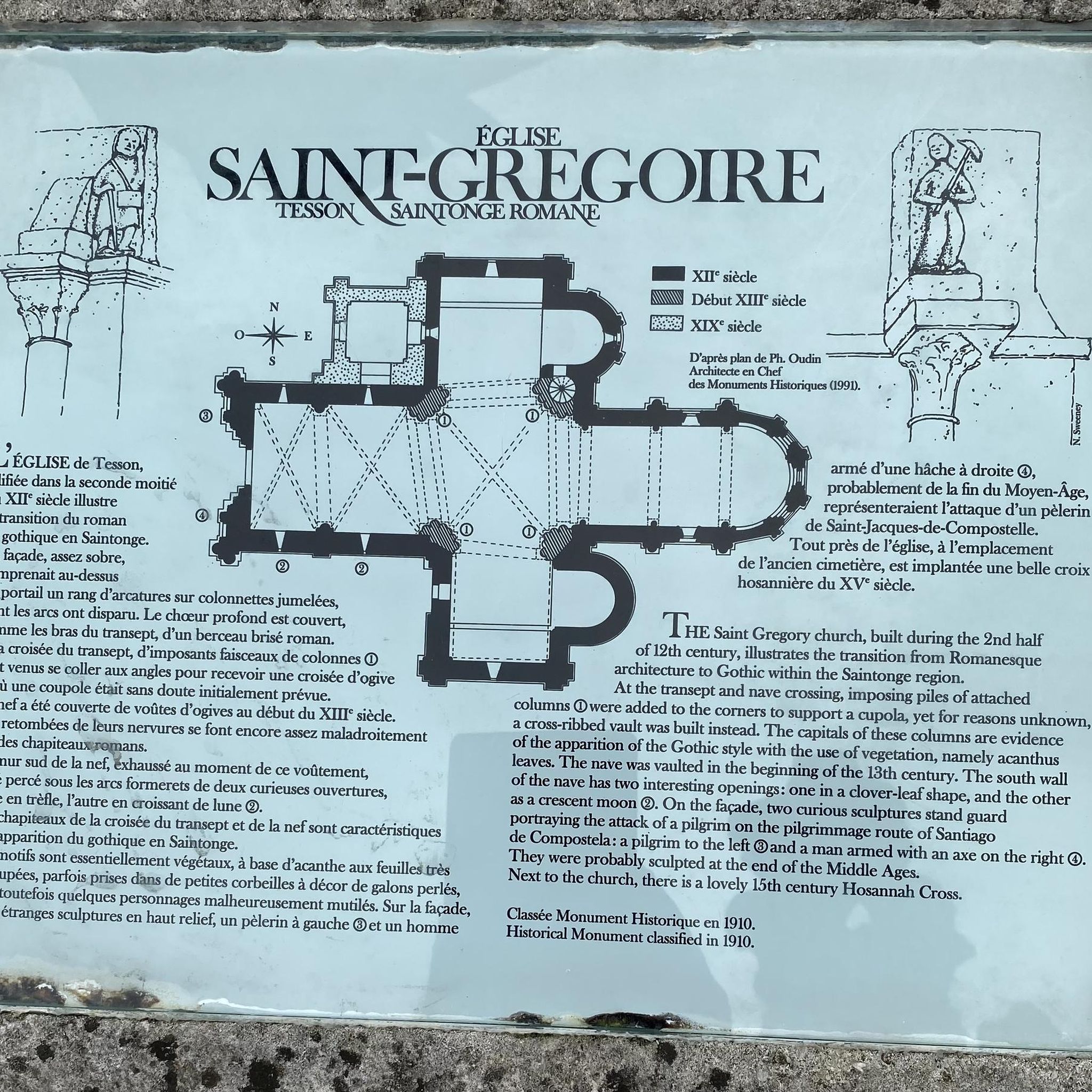
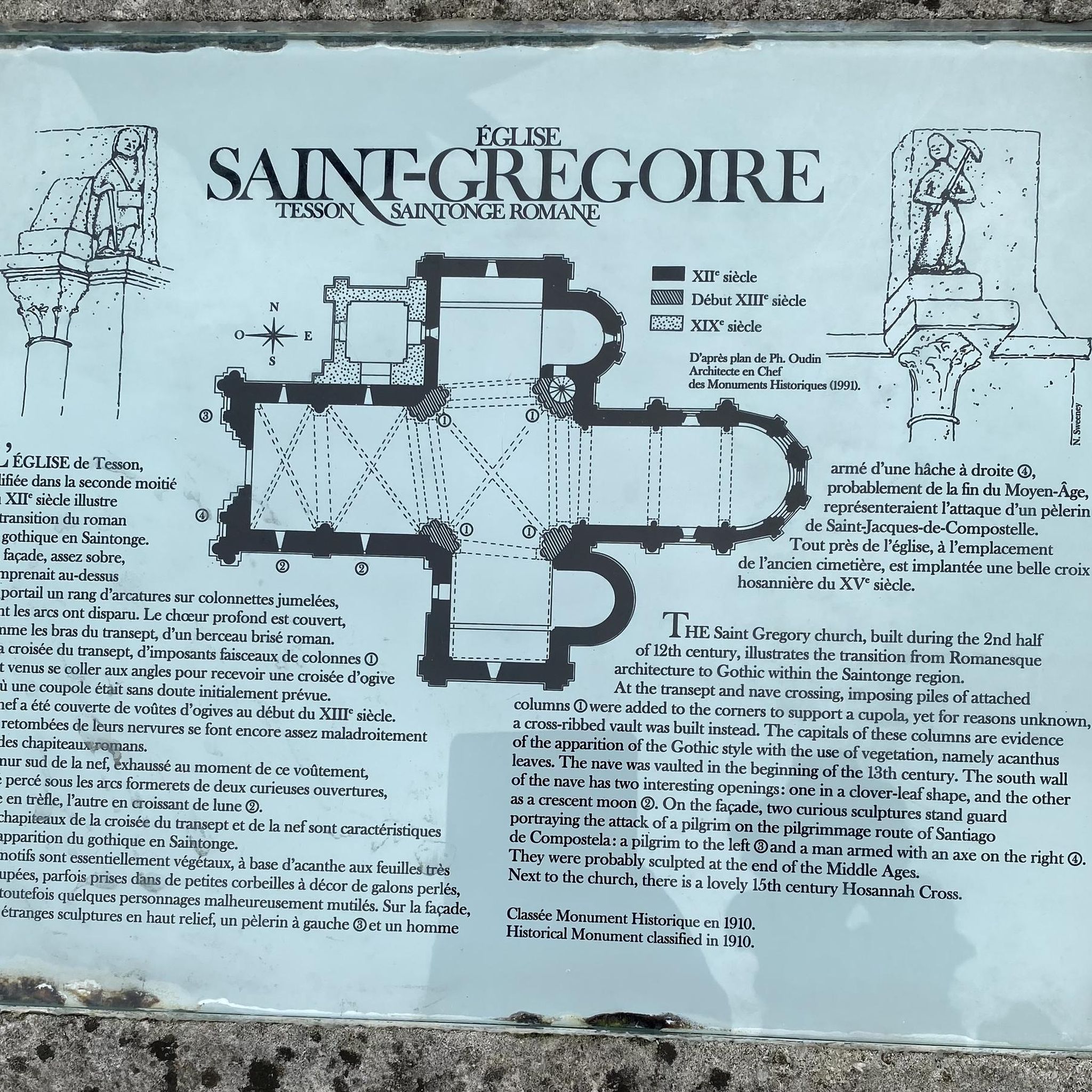
The church of Saint-Pierre de Gémozac is a composite style religious building which incorporates both a Saintonge Romanesque structure and Gothic elements. It is one of the few churches in the region bearing witness to the transition between the two styles and has been listed as a Historic Monument since 1910.
0
0
Οι πιο δημοφιλείς διαδρομές Tesson

Εμπνεύσου με την εφαρμογή komoot για κινητά


Ανακάλυψε περισσότερα
Δεν βρήκες ακόμη το Highlight που ψάχνεις; Δες οδηγούς για τα κορυφαία αξιοθέατα σε άλλες περιοχές:
